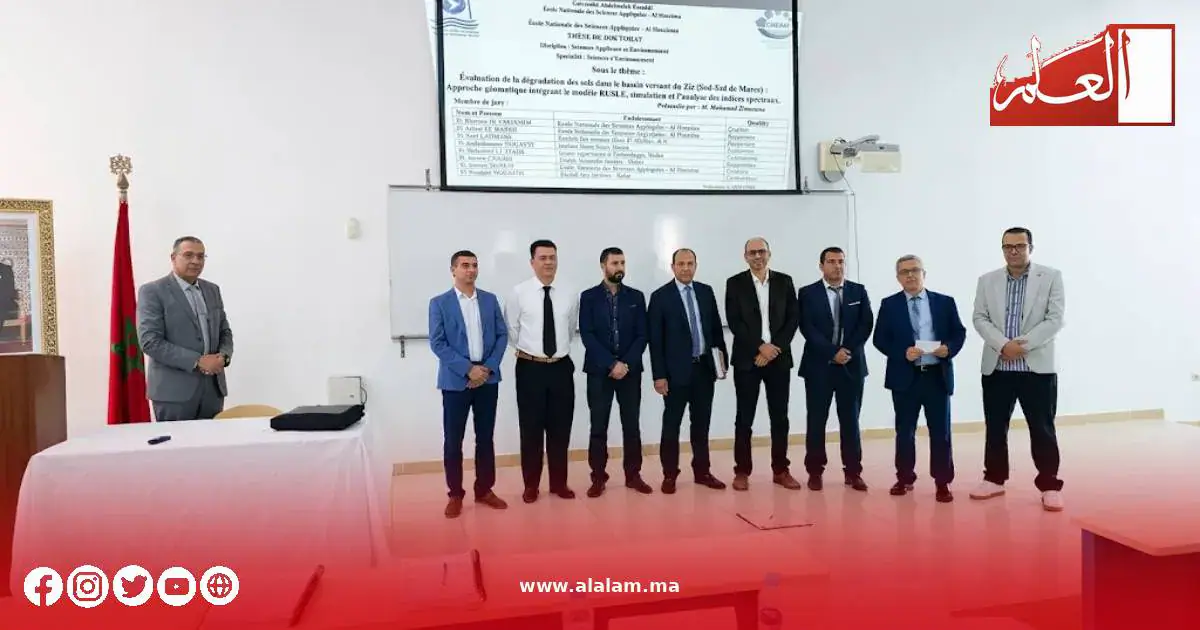
A doctoral thesis recently discussed at the National School of Applied Sciences in Al-Hoceima, Morocco, has shed light on the critical environmental challenges facing the Ziz Basin in southeastern Morocco. The study, conducted by Mohamed Ameziane under the supervision of Professor Nordine Nouayti, employed a comprehensive approach combining remote sensing, geographic information systems (GIS), spatial modeling, and fieldwork to assess soil degradation and erosion in the region. The research aimed to understand the mechanisms of soil deterioration and evaluate its spatiotemporal evolution in the Ziz Basin.
The study's findings revealed significant desertification in the upper part of the Ziz Basin between 2000 and 2024. Analysis of Landsat satellite images using Tasseled Cap spectral transformations enabled the development of models to monitor desertification, classifying the area into five degradation levels. The results showed an increase in areas affected by moderate and severe desertification. Furthermore, the application of the RUSLE model integrated with GIS indicated that soil loss generally ranges from weak to moderate, with an annual average of approximately 1.36 tons per hectare.
The research also highlighted the high vulnerability of the upper areas of the basin to erosion due to rugged terrain and strong slopes. A notable contribution of the thesis was the conduct of rainfall simulation experiments on field plots, which allowed for the study of infiltration, surface runoff, and soil detachment. These experiments revealed that actual soil loss can exceed values estimated by the RUSLE model. Physical and chemical analyses of soil samples showed low organic matter and nutrient content, increasing the soil's susceptibility to degradation and erosion.
The study also tracked the evolution of vegetation cover and bare areas from 1990 to 2022 using NDVI, EVI, and BSI spectral indices. The results indicated relative stability in land cover, with local improvements in vegetation cover and limited expansion of bare areas. The reliability of the research was enhanced by combining digital analysis, spatial modeling, and field and laboratory verification through measurements and soil sample analysis.
The thesis provided a comprehensive methodological approach, offering accurate scientific data and maps that can support decision-making and prioritize areas for intervention. The study's findings can guide conservation programs and sustainable resource management in the Ziz Basin and similar dry regions in Morocco. The research was defended before a scientific committee comprising professors from various Moroccan universities.
The study's outcomes are crucial in addressing environmental challenges related to climate change and desertification, supporting sustainable development strategies in vulnerable regions. The research contributes to the development of modern tools for monitoring environmental changes and understanding the dynamics of natural resource degradation. The findings and recommendations of the thesis can inform policymakers and stakeholders about the urgent need for sustainable resource management in the Ziz Basin.
The doctoral thesis of Mohamed Ameziane has been recognized as a significant scientific contribution, providing valuable insights into the environmental challenges facing Morocco's Ziz Basin. The study's results and recommendations are expected to contribute to the development of effective strategies for sustainable resource management and environmental conservation in the region. The research has also highlighted the importance of interdisciplinary approaches in addressing complex environmental challenges.
Key points
- The study revealed significant desertification and soil erosion in Morocco's Ziz Basin, with an annual average soil loss of approximately 1.36 tons per hectare.
- The research employed a comprehensive approach combining remote sensing, GIS, spatial modeling, and fieldwork to assess soil degradation and erosion.
- The study's findings can inform policymakers and stakeholders about the urgent need for sustainable resource management in the Ziz Basin and similar dry regions in Morocco.