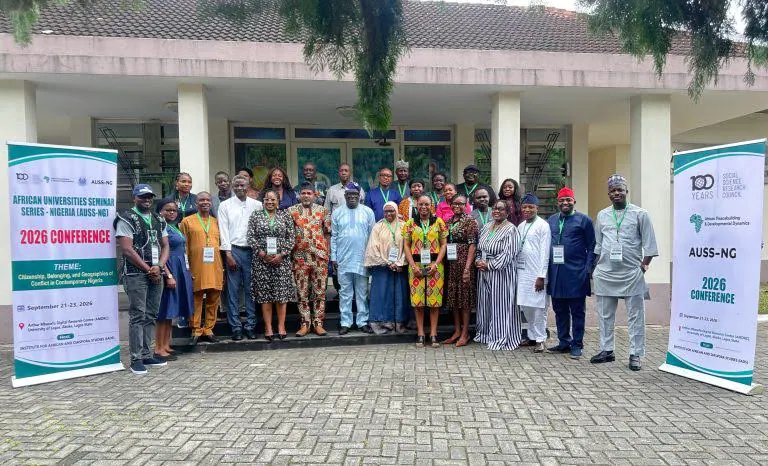
The African Universities Seminar Series–Nigeria (AUSS-NG) has raised concerns about the deepening conflict and insecurity in Nigeria, citing structural inequalities and exclusion as major factors. The organization has called for the reconstruction of Nigerian citizenship around inclusion, equality, participation, and social justice. This was one of the key recommendations made at the end of the second AUSS-NG conference, hosted by the University of Lagos Institute for African and Diaspora Studies (IADS). The conference brought together scholars, researchers, and practitioners to examine the theme of citizenship, belonging, and geographies of conflict in contemporary Nigeria.
The conference featured 25 papers, including a keynote paper, a lead paper, and 23 plenary papers. According to Victor Ogbonnaya Okorie, Professor of Development at Obafemi Awolowo University (OAU), the discussions identified diverse geographies of conflict and forms of belonging, including conditional citizenship. Okorie noted that each geography of conflict contains a triangle of violence involving perpetrators, victims, and witnesses, whose memories and experiences may vary. The scholars observed that violence is fungible, with individuals able to switch roles from victim to perpetrator.
The conference distinguished between subjective violence, experienced through community and interpersonal conflicts, and objective or structural violence embedded in institutional and governmental arrangements. Okorie noted that unequal access to resources, land, education, employment, and public institutions can foster exclusion and deepen social divisions. The scholars emphasized the need for peacebuilding interventions to address not only immediate violence but also the institutional, economic, social, and political structures that reproduce inequality and conflict.
The AUSS-NG conference recommended integrating indigenous African knowledge systems, local conflict-management mechanisms, and community-based practices into national, regional, and global peacebuilding frameworks. The scholars also called for stronger recognition of women's informal peacebuilding roles in homes, markets, religious spaces, and communities as legitimate components of conflict prevention, mediation, and reconciliation. Furthermore, they urged closer links between informal community-based peacebuilding initiatives and formal governmental, institutional, and international mechanisms.
The conference emphasized the importance of education in promoting peace and social justice. The scholars recommended treating learning as a fundamental component of peacebuilding, rather than just a tool for economic development. They also called for greater recognition of locally generated peacebuilding initiatives and community knowledge, rather than relying exclusively on elite-driven or top-down approaches.
The AUSS-NG conference also highlighted the need for the government to move beyond conventional commemorative remembrance of past conflicts to what they described as reparative memory. This approach acknowledges historical injustices, restores the dignity of victims, and helps prevent the recurrence of violence. The scholars' recommendations were contained in a communiqué issued at the end of the conference and signed by Okorie.
The AUSS-NG conference concluded with a call for urgent action to address the deepening conflict and insecurity in Nigeria. The scholars emphasized that the reconstruction of Nigerian citizenship around inclusion, equality, participation, and social justice is crucial to promoting peace and social justice. They also stressed the need for greater recognition of the complex relationships between citizenship, belonging, and geographies of conflict in contemporary Nigeria.
Key points
- Scholars call for reconstruction of Nigerian citizenship around inclusion, equality, participation, and social justice
- Conference recommends integrating indigenous African knowledge systems into national and global peacebuilding frameworks
- Scholars emphasize need for greater recognition of locally generated peacebuilding initiatives and community knowledge