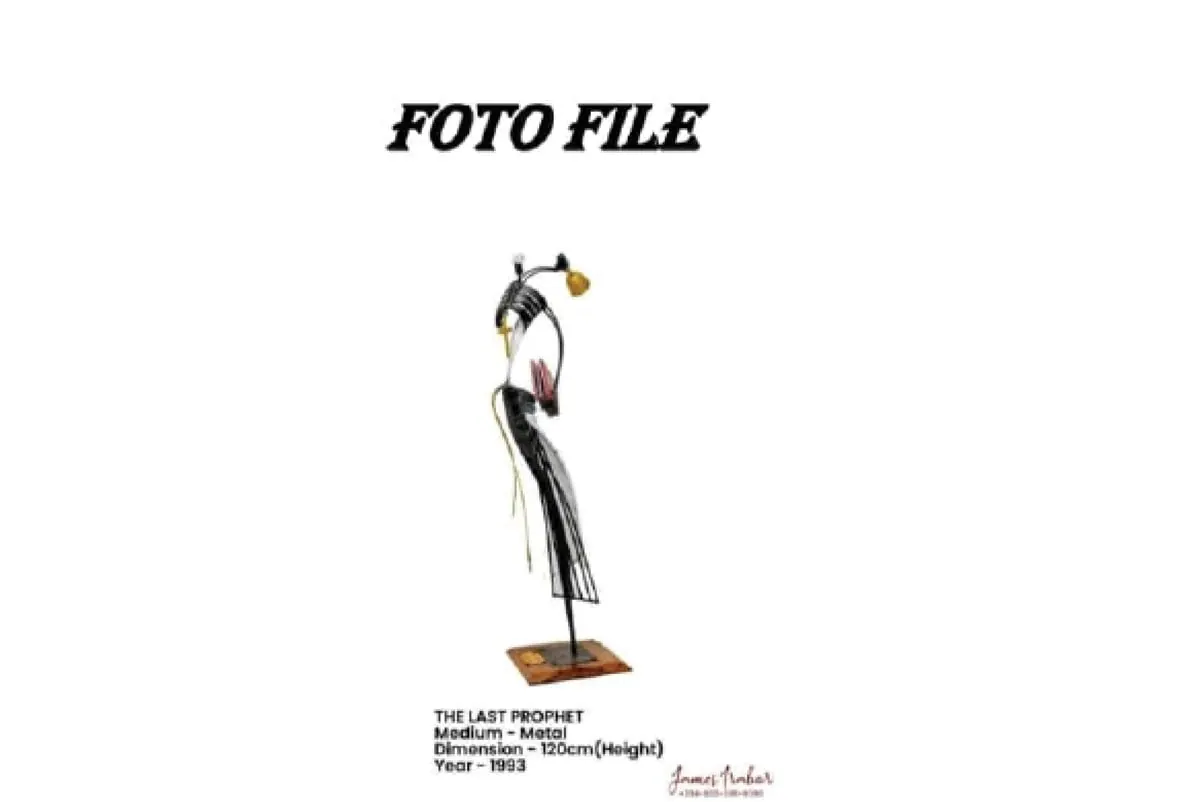
Renowned Nigerian artist James Irabor has introduced his latest masterpiece, 'The Last Prophet,' a thought-provoking sculpture that explores the intersection of visual symbols, materials, and gestures in communicating meaning beyond physical form. The artwork, crafted from rods and steel, is mounted on a wooden panel and suspended in space, presenting a stylized human figure engaged in an expressive act of preaching. This piece is a reflection of Irabor's interest in using art to comment on societal issues.
The sculpture's stylized human form emphasizes expressive gesture and posture over anatomical accuracy, embodying religious authority, spiritual leadership, and public proclamation of belief. The title, 'The Last Prophet,' suggests a critical perspective on the proliferation of self-proclaimed prophets and religious figures in contemporary society. Irabor's work invites viewers to reflect on the attitudes and behavioral patterns associated with religious extremism and bigotry.
A key element of the sculpture is the suspension of the human figure above the wooden panel, giving the impression that it floats in space. This technique may signify spiritual elevation or transcendence, separation from ordinary human life, or charismatic authority and supernatural influence. By suspending the figure, Irabor may be symbolizing the detachment of the prophet from social reality, operating within a self-constructed spiritual realm.
The dynamic posture of the sculpture, particularly the swing of the right hand holding a bell, implies active preaching, commanding attention, and charismatic performance. The extended arm visually communicates the act of proclamation, reinforcing the idea that the figure is addressing a congregation. Although no physical congregation is present, the direction of gesture and posture implies the presence of an imaginary audience.
Irabor's use of industrial materials transformed into a powerful symbolic commentary on religion, leadership, and belief systems is noteworthy. Through abstraction and expressive metal construction, he has created a layered narrative that critiques societal attitudes toward self-proclaimed prophets and religious figures. The sculpture's message is both representational and satirical, encouraging viewers to reflect on their own perceptions of religious authority.
According to Ayo Elebute, Professor of Journalism, Media and Cultural Studies, the elements of gesture, suspension, the bell, and stylized human form in Irabor's sculpture communicate a complex narrative. Elebute notes that Irabor's work is a reflection of his interest in using art to comment on societal issues, and 'The Last Prophet' is a significant addition to his repertoire.
James Irabor's 'The Last Prophet' sculpture is a thought-provoking piece that challenges viewers to reflect on their perceptions of religious authority and societal attitudes toward self-proclaimed prophets. The artwork's use of industrial materials, abstraction, and expressive metal construction creates a powerful symbolic commentary on religion, leadership, and belief systems in contemporary society.
Key points
- The sculpture critiques societal attitudes toward self-proclaimed prophets and religious figures.
- The artwork uses industrial materials transformed into a powerful symbolic commentary on religion, leadership, and belief systems.
- The sculpture's suspension technique and dynamic posture convey a complex narrative about spiritual authority and charismatic performance.