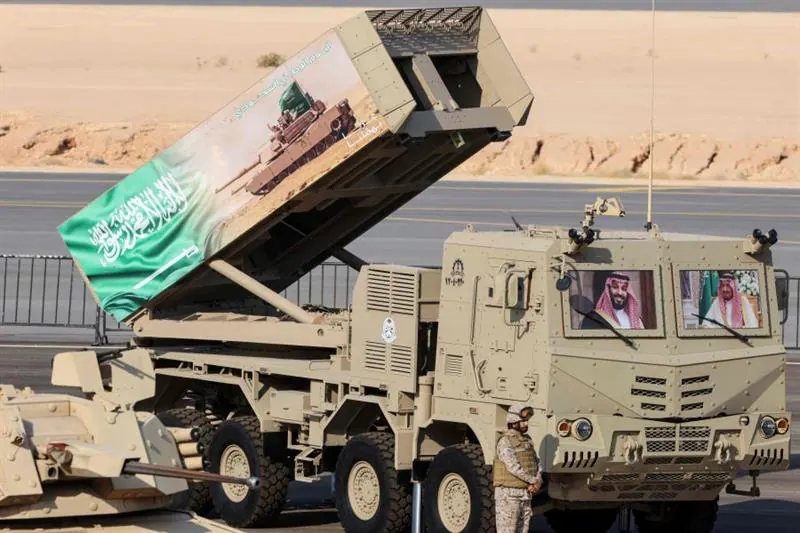
The Mecca defense pact, signed in August by Saudi Crown Prince Mohammed bin Salman, Turkish President Recep Tayyip Erdogan, and Pakistani Prime Minister Shehbaz Sharif, aims to establish a collective defense agreement among the three countries. The agreement stipulates that an armed attack against any one of the three countries would be regarded as an attack against all three. This pact was formed to strengthen the security and stability of the region.
Despite the Houthi attacks on Saudi cities and energy infrastructure, neither Turkey nor Pakistan has launched direct military action against the group in Yemen. The Houthis have advanced along Yemen's Red Sea coast and tightened their grip around the Bab el-Mandeb Strait, a strategic maritime chokepoint. The group has also launched missile and drone attacks against Saudi targets, including Riyadh and energy infrastructure.
Saudi Arabia entered the Yemen war in 2015 at the head of a coalition supporting the internationally recognized Yemeni government and seeking to push back the Houthis. Years of fighting were followed by a period of relative calm after a United Nations-brokered truce in 2022, but the conflict has now returned to the centre of regional security concerns. The Saudi-led coalition has been working to stabilize the region and prevent further escalation.
Turkish Foreign Minister Hakan Fidan stated that Turkey is prepared to help Saudi Arabia under the trilateral defense agreement. Fidan emphasized that Turkey sees the attacks on Saudi Arabia's territorial integrity and sovereignty as a serious issue and expressed solidarity with Saudi Arabia. He mentioned that Turkey would have no issues in meeting Saudi Arabia's military needs, especially on technical issues.
Pakistan's position has evolved in recent days, with its political and military messaging appearing to leave the scope and timing of any response open. Pakistani Defence Minister Khawaja Asif initially warned that an attack on Saudi Arabia could activate the Makkah defense pact. However, the Foreign Ministry spokesperson later stated that no immediate military response under the pact was being considered.
A week later, Pakistan's military gave a stronger public assurance, stating that Islamabad would go "to any extent" to defend Saudi Arabia against an attack. Lieutenant General Ahmed Sharif Chaudhry, director-general of the Inter-Services Public Relations, emphasized that Pakistan's commitment to Saudi Arabia's security is unconditional. This statement highlights Pakistan's willingness to support Saudi Arabia in the face of growing threats.
The Mecca defense pact faces challenges in transforming a political commitment into an operational defense mechanism. Building an effective defense architecture requires established command structures, rules of engagement, intelligence-sharing mechanisms, interoperable air-defense systems, and logistical arrangements. The timing of the Houthi attacks has exposed a gap between the signing of the defense agreement and the creation of fully integrated military capabilities.
Key points
- The Mecca defense pact faces its first major test amid escalating Houthi attacks on Saudi Arabia.
- Turkey and Pakistan have not launched direct military action against the Houthis in Yemen despite the attacks.
- The pact faces challenges in transforming a political commitment into an operational defense mechanism.