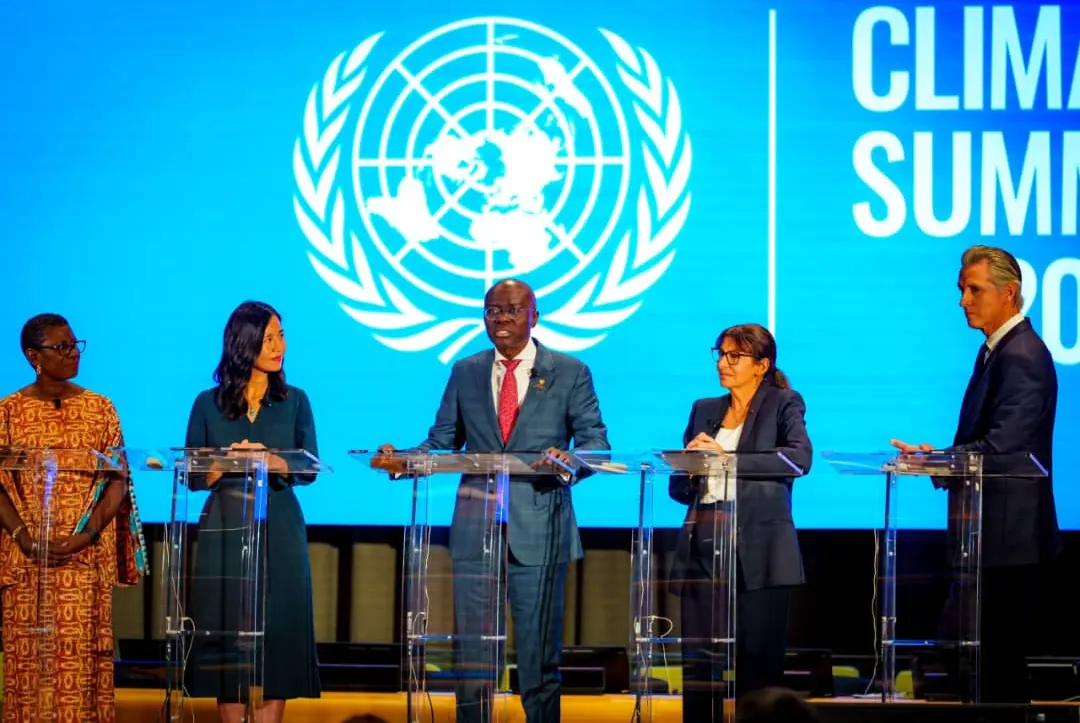
Lagos State Governor Babajide Sanwo-Olu has urged world leaders to provide stronger partnerships and increased access to affordable, long-term financing for states, regions, and other subnational governments to accelerate climate action. He made this call at the United Nations High-level Meeting on Climate Action and the Just Transition during the 81st session of the United Nations General Assembly in New York. The meeting focused on accelerating the energy transition, strengthening climate adaptation, and mobilizing finance for climate action.
Sanwo-Olu addressed the meeting as a representative of the Under2 Coalition, a global network of state and regional governments committed to climate action. He emphasized that climate action is about turning ambition into opportunity, protecting people, strengthening the economy, and building a more resilient and prosperous state for generations to come. The governor highlighted Lagos' efforts to address climate challenges associated with rapid urban growth, including moves towards cleaner transportation and initiatives to derive economic value from solid waste.
Lagos generates over 5,000 tonnes of solid waste daily and is implementing initiatives to recycle and derive economic value from it through circular economy approaches and clean energy. Sanwo-Olu stressed that these efforts are not abstract climate policies but decisions that can create jobs, improve services, strengthen resilience, and make everyday life better for millions of people. He also emphasized the role of subnational governments in implementing climate policies and called for stronger cooperation among states and regions to accelerate climate action.
Sanwo-Olu appeared alongside California Governor Gavin Newsom and highlighted the importance of access to affordable, long-term financing for subnational governments to translate climate plans into infrastructure and other projects. He called on development finance institutions, investors, and the private sector to see the opportunity in climate investment in emerging markets. The governor emphasized that states and regions are ready to deliver climate solutions but need partnerships and investment to do so at scale.
The governor's intervention comes as Lagos prepares the next phase of its climate strategy through the Office of Climate Change and Circular Economy (OCCE). The office, led by Special Adviser to the governor on Climate Change and Circular Economy, Titilayo Oshodi, is working to translate the state's climate priorities under its State-Determined Contributions (SDCs) Framework into projects and implementation plans. Oshodi said the state is focusing on creating investment opportunities around its climate priorities.
Lagos is developing a Lagos Climate Finance and Investment Platform to connect the state's climate priorities with capital, technology, financial institutions, and implementation partners. The platform will focus on areas including climate finance, deal-making, Article 6 and climate assets, digital measurement and verification, as well as international partnerships. Sanwo-Olu's UN engagement forms part of Lagos' wider international climate programme ahead of COP31 in Antalya, Türkiye.
The governor's call for climate finance and partnerships is part of Lagos' efforts to engage investors, development finance institutions, financial institutions, project developers, and technology partners on its climate investment priorities. The state aims to build a more resilient and prosperous future for its citizens by accelerating climate action and mobilizing finance for climate projects. Sanwo-Olu's advocacy for subnational governments highlights the critical role they play in implementing climate policies and achieving climate goals.
Key points
- Sanwo-Olu calls for stronger partnerships and increased access to affordable financing for subnational governments to accelerate climate action.
- Lagos is developing a climate finance and investment platform to connect its climate priorities with capital and implementation partners.
- The governor emphasizes the need for development finance institutions, investors, and the private sector to support climate investment in emerging markets.