Samsung's journey in technology began in 1938, with the company tracing its origins to that year. The formation of Samsung Electronics in 1969 marked a significant milestone, as the company began to expand its product line beyond consumer electronics to include smartphones, televisions, home appliances, displays, semiconductors, wearables, and artificial intelligence. Over the decades, Samsung has consistently pushed the boundaries of innovation, introducing products and technologies that have challenged established ideas and created new product categories.
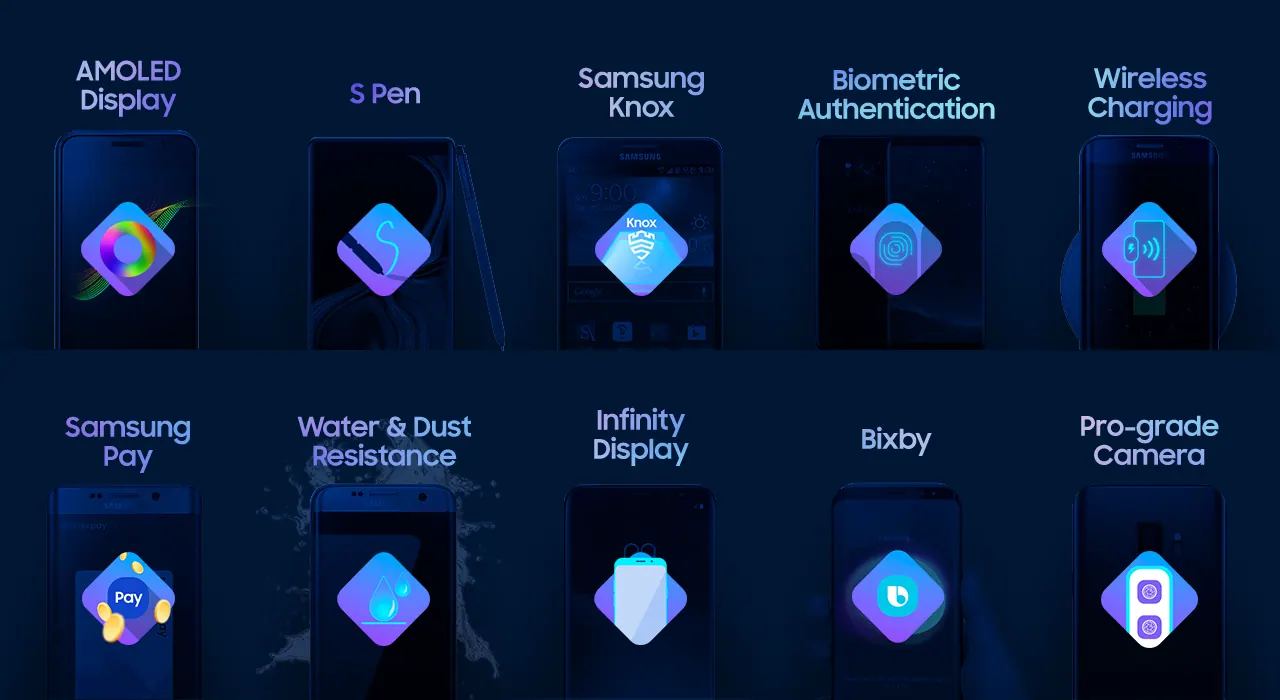
One of Samsung's earliest innovations was the Super AMOLED display, launched in 2010 with the Galaxy S smartphone. This technology combined the touch sensor and display into a single layer, producing a thinner device with strong contrast and vivid colors. The Super AMOLED display helped establish the display as a defining feature of the modern smartphone, and Samsung continued to develop its AMOLED technology through successive generations of Galaxy smartphones.
In 2011, Samsung introduced the Galaxy Note, which combined a large smartphone display with the S Pen digital stylus. This concept allowed users to write notes, draw, annotate documents, and interact with the phone using the pen. The Galaxy Note helped establish a category of devices that sat between conventional smartphones and tablets, and the S Pen subsequently became one of Samsung's defining Galaxy features.
As smartphones became increasingly important for work, Samsung introduced Knox in 2013, a security platform designed to protect devices and data. Knox created a secure environment that could separate work information from personal data on the same smartphone, addressing growing concerns about mobile device security. The platform has since expanded to cover Samsung smartphones, tablets, wearables, and other connected products.
Samsung's innovation has not been limited to smartphones. In 2013, the company unveiled the world's first Curved UHD TV, combining ultra-high-definition resolution with a curved display. The curved design aimed to create a more immersive viewing experience, and five years later, Samsung introduced The Wall, a 146-inch MicroLED display described as the world's first modular TV for consumers.
Some of Samsung's technology milestones have been less visible but more directly connected to everyday life. In 1995, the company introduced Twin Cooling technology for refrigerators, using separate cooling systems for the refrigerator and freezer compartments. This approach allowed for more efficient temperature management and limited the transfer of odors between compartments.
Samsung's commitment to innovation has continued with products like Eco Bubble, which mixes air, water, and detergent to create bubbles that can penetrate fabrics more quickly, delivering effective cleaning at lower temperatures. The company's focus on connected-home strategy, including SmartThings and appliances equipped with artificial intelligence, has also transformed the way people interact with household appliances.
Key points
- Samsung's innovations have consistently challenged established ideas and created new product categories.
- The company's focus on security, display technology, and artificial intelligence has transformed the way people use electronics.
- Samsung's commitment to innovation has led to numerous groundbreaking products and technologies that have shaped the technology future.