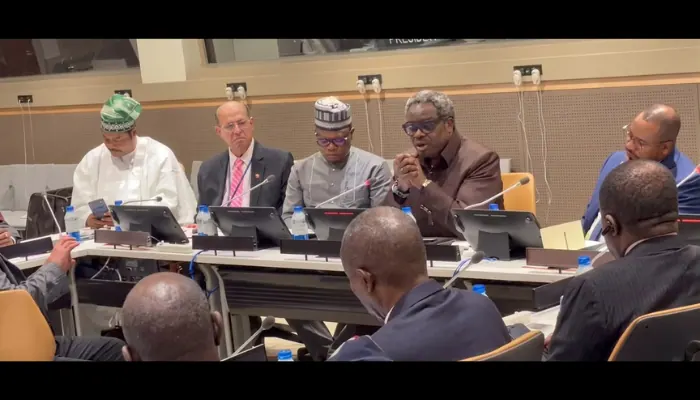
Sahara Group is calling on global investors and policymakers to increase sustainable investment and climate finance for Africa, citing the continent's growth prospects as dependent on building resilient economies. Kola Adesina, group managing director of Sahara Power Enterprise Group, made the appeal at a United Nations General Assembly roundtable on Sustainable Global Investment, Economic Resilience and Climate Financing. Africa's development agenda cannot be met without treating investment, resilience, and climate finance as linked priorities.
Adesina highlighted Africa's pressing challenge of expanding its productive capacity at scale, requiring sustained investment in energy, infrastructure, industry, agriculture, and enterprise development. This investment is necessary to create jobs, strengthen competitiveness, and support long-term resilience. The continent faces significant financing gaps, with nearly 600 million people in Sub-Saharan Africa lacking access to electricity and an annual infrastructure financing shortfall of $68 billion to $108 billion.
The global capital pool available to close this gap is growing, but Africa's share lags. Foreign direct investment worldwide totaled roughly $1.6 trillion in 2025, while assets tied to sustainable investment strategies have reached $16.7 trillion globally. This indicates rising investor appetite for projects combining financial returns with measurable development impact. Adesina argued that Africa requires substantial investment not only to grow but also to protect infrastructure, businesses, food systems, and communities.
Climate finance is a central theme in Adesina's remarks, as African economies are increasingly exposed to droughts, floods, and extreme heat despite accounting for less than 4 percent of global greenhouse-gas emissions. The continent bears disproportionate climate risk without the resources to manage it. African countries need an estimated $277 billion annually to meet their national climate commitments, against actual climate-finance flows of roughly $30 billion a year.
The financing gap underscores the challenge, with conventional funding channels insufficient to mobilize capital for emissions mitigation and climate adaptation. Sahara positioned its own portfolio as a template for the kind of investment it is calling for, with a net-zero ambition by 2060 resting on gas infrastructure development, renewable energy integration, and nature-based solutions. The company's sustainability push is framed under a platform called Beyond XXX.
Adesina laid out structural fixes needed to convert investor interest into projects on the ground, including stronger project preparation, greater mobilization of African institutional capital, and deeper local-currency financing markets. Closer regional collaboration on cross-border energy, transport, and logistics infrastructure is also necessary. These fixes can help unlock Africa's opportunity for resilient prosperity, where investment translates into productive capacity, jobs, and sustainable economic growth.
The roundtable was held on the sidelines of the UN General Assembly session in New York, where climate financing and development funding have featured prominently in discussions. Sahara's appearance adds a corporate voice from Africa's energy sector to a debate shaped by government pledges and multilateral development bank commitments.
Key points
- African countries need $277 billion annually to meet national climate commitments.
- The continent faces an annual infrastructure financing shortfall of $68 billion to $108 billion.
- Africa accounts for less than 4 percent of global greenhouse-gas emissions but bears disproportionate climate risk.