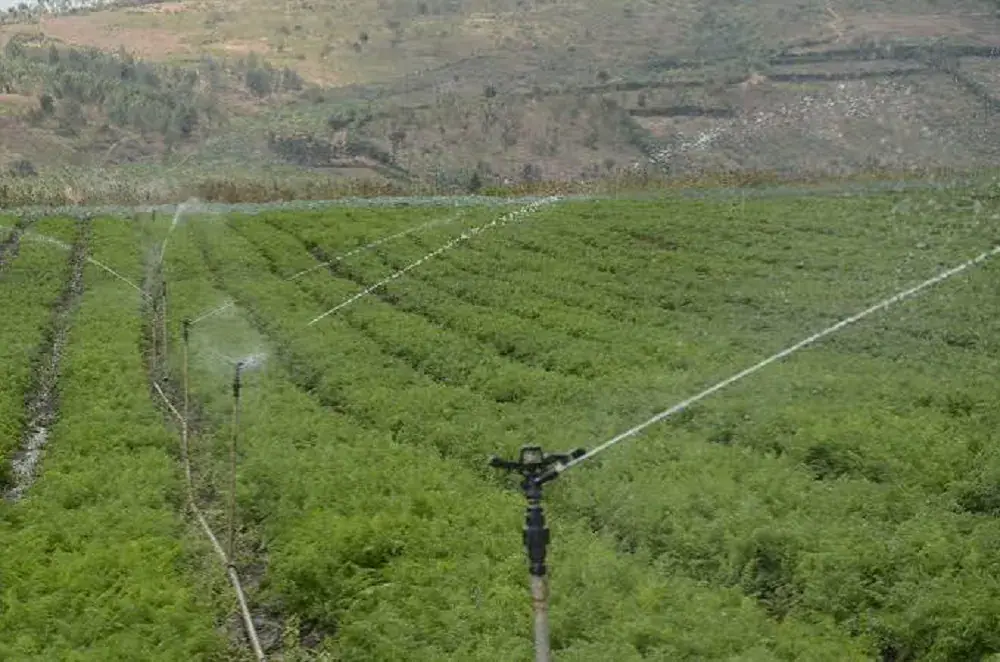
The Rwanda Agricultural Board (RAB) has announced that the government will continue to support small-scale farmers in accessing irrigation machines through subsidies. This was revealed during a technical meeting organized by the Coalition of Civil Society Organizations Supporting Community Development (CCOAIB) on September 24, 2026. The meeting aimed to assess the implementation of the "Twiyubakire-Engage" project, which seeks to improve agricultural productivity among small-scale farmers.
The project, which is being implemented in the districts of Muhanga, Nyaruguru, Nyamagabe, and Gatsibo, found that small-scale farmers face significant challenges in accessing irrigation equipment and knowledge on how to use and maintain them. As a result, many farmers are not able to maximize their crop yields. Bazi Frodouard, a farmer from Gatsibo district, highlighted the difficulties his cooperative faces in accessing irrigation equipment, stating that they have only 12 machines, which are no longer functional.
Frodouard further explained that the high cost of seeds and lack of access to irrigation equipment hinder farmers from increasing their productivity. He appealed for support to repair or replace broken machines, which would enable farmers to improve their yields. Currently, the government provides a 50% subsidy on diesel and petrol-powered irrigation machines, while those using solar-powered machines receive a 75% subsidy.
Ngendandumwe Jean Claude, Secretary General of CCOAIB, emphasized the need for the government to support farmers in accessing affordable irrigation equipment. He suggested that instead of relying solely on subsidies, farmers should be encouraged to invest in irrigation equipment and explore alternative financing options. Dr. Uwamahoro Frorence, CEO of RAB, assured farmers that the government will continue to support them in accessing irrigation machines through subsidies and other initiatives.
Dr. Uwamahoro Frorence explained that the government is promoting the use of solar-powered irrigation machines, which are more expensive but environmentally friendly. She revealed that RAB has allocated funds to support farmers in purchasing irrigation equipment, including through partnerships with organizations such as SAIP and CDAT. The government aims to increase the use of irrigation machines, particularly among small-scale farmers, to improve agricultural productivity.
According to RAB, Rwanda has a total of 596,810 hectares of arable land, with only 71,585 hectares (12%) currently being irrigated. The government aims to increase the area under irrigation to 132,171 hectares by 2029, with a focus on supporting small-scale farmers. To achieve this goal, the government will need to provide support to farmers in accessing irrigation equipment and knowledge.
The "Twiyubakire-Engage" project aims to improve agricultural productivity among small-scale farmers by providing them with access to irrigation equipment, knowledge, and markets. The project has been implemented in several districts, including Muhanga, Nyaruguru, and Nyamagabe. Through this project, the government hopes to increase crop yields and improve the livelihoods of small-scale farmers.
Key points
- The Rwandan government has pledged to support small-scale farmers in accessing irrigation machines through subsidies and other initiatives.
- The government aims to increase the area under irrigation to 132,171 hectares by 2029, with a focus on supporting small-scale farmers.
- The use of solar-powered irrigation machines is being promoted as a more environmentally friendly option.
Reporting sources
- RAB yijeje abahinzi gukomeza kubafasha kubona imashini zuhira · https://umuseke.rw/