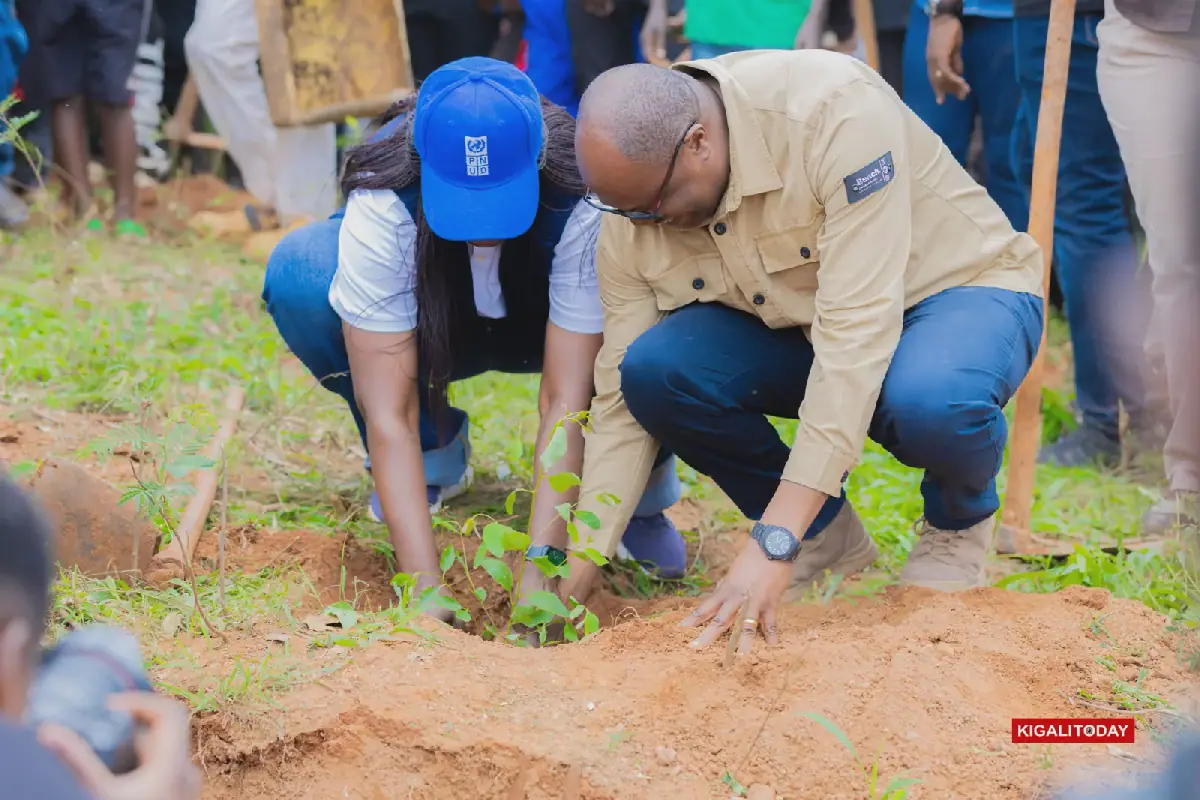
Prime Minister Dr. Justin Nsengiyumva has urged every Rwandan household to make tree planting a routine part of their lives. Speaking during a community tree-planting exercise in Kamonyi district, Nsengiyumva emphasized the importance of restoring degraded forests and using trees as a source of food, agricultural productivity, and protection against climate-related shocks. He encouraged residents to plant and care for trees, particularly fruit-bearing varieties, to contribute to household nutrition.
The tree-planting exercise in Kamonyi district aimed to plant 1.4 million trees this year, with 12,100 trees planted across 5.5 hectares at the Kanyinya site. The site is part of a 38.25-hectare forest restoration program under the Forest Investment Program – Development of Agroforestry for Sustainable Agriculture in Rwanda (FIP-PRODAR). The program will provide 15,174 fruit trees and up to 479,000 trees that can be integrated into crop farming, promoting environmental conservation and sustainable agriculture practices.
Nsengiyumva stressed the importance of integrating trees into farming systems to protect agricultural land, improve productivity, and strengthen communities' ability to cope with changing weather patterns. Agroforestry can help farmers diversify production, protect soils, and obtain additional food and income from the same landscapes used for crop cultivation. Fruit trees offer an opportunity to connect environmental restoration with improved household diets.
The Prime Minister also warned residents about the need to prepare for climate-related disasters, including El Niño, and emphasized that environmental protection should be accompanied by practical measures that strengthen community resilience. In Kamonyi, the tree-planting program is complemented by the Least Developed Country Fund IV (LDCF-IV), a $20 million climate-resilience initiative that aims to build community resilience through systems-based adaptation and integrated resource management.
The push to make trees productive has also been extended into Rwanda's urban areas, where rapid urbanization places increasing pressure on green spaces, biodiversity, and food systems. Rwanda has launched an initiative to plant approximately 55,000 grafted fruit trees across Kigali and surrounding urban areas, aiming to transform underutilized spaces into productive urban forests. The Edible Urban Forests Initiative seeks to improve access to nutritious food, increase urban biodiversity, and address environmental challenges.
The emphasis on productive green spaces gives the urban program a broader purpose than simply increasing the number of trees in the city. It seeks to make environmental assets contribute directly to the wellbeing of urban communities. Meanwhile, in Rwamagana district, Chief Justice Domitille Mukantaganzwa joined residents to plant 12,000 trees near Lake Muhazi, urging residents to protect the environment and increase efforts to plant different varieties of trees, including fruit-bearing species.
Key points
- The tree-planting program aims to restore degraded forests, improve agricultural productivity, and enhance household nutrition.
- The initiative seeks to make environmental assets contribute directly to the wellbeing of urban communities.
- The program combines forest conservation, agroforestry, and climate adaptation to support both livelihoods and environmental sustainability.