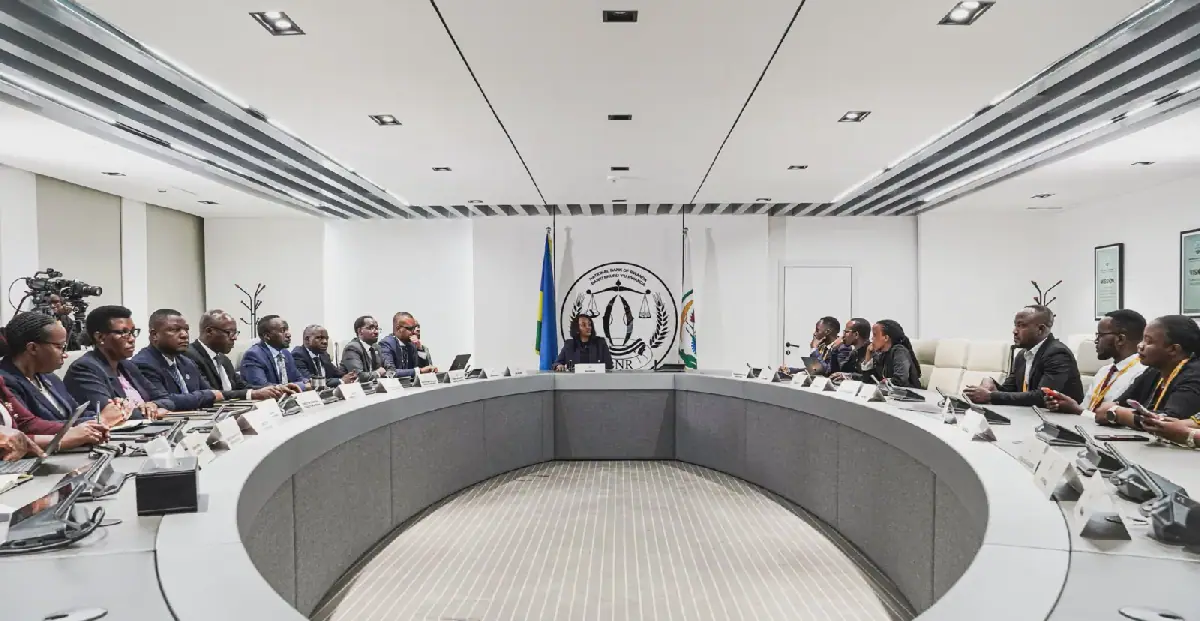
The National Bank of Rwanda has increased its Central Bank Rate from 8.75% to 9.5%, a 75 basis point hike, in an effort to control rising inflation. Governor Soraya Hakuziyaremye announced the decision following a Monetary Policy Committee meeting that reviewed domestic and international economic developments. The move aims to address mounting inflationary pressures, particularly from food prices, which have driven up the cost of living for households.
Rwanda faces significant inflationary pressures, with annual headline inflation averaging 15.8% in the third quarter of 2026, up from 13.2% in the previous quarter. Inflation further increased to 19.5% in October, according to the National Institute of Statistics of Rwanda. Fresh food prices surged 39.9% year-over-year in October, while the overall food and non-alcoholic beverages category recorded an annual increase of 28.9%. Core inflation, excluding fresh food and energy prices, stood at 11.5%.
The central bank aims to maintain inflation within a target range of 2% to 8%, with a medium-term objective of 5%. To achieve this, the bank uses the Central Bank Rate as a tool to influence borrowing costs and control the money supply. A higher policy rate generally leads to higher interest rates charged by commercial banks, making loans more expensive for households and businesses, which can reduce borrowing and spending.
The effects of the rate hike extend to money markets, with Rwanda's interbank rate averaging 8.44% in the third quarter of 2026, up from 5.85% during the same period last year. This reflects the impact of tighter monetary conditions. However, higher interest rates can also increase financing costs for businesses, potentially slowing investment and economic activity.
The monetary tightening comes against a backdrop of strong economic growth, with Rwanda's economy expanding by 9.4% year-over-year in the second quarter of 2026, driven mainly by services and industry. The challenge for monetary authorities is to bring inflation under control without undermining economic growth momentum.
The National Bank of Rwanda expects inflation to begin easing progressively from the second quarter of 2027, returning to its target range by the end of that year. However, the outlook remains exposed to several risks, including adverse weather conditions that could disrupt agricultural production and push food prices higher. Geopolitical tensions in the Middle East are also a potential source of further increases in international energy and commodity prices.
The Monetary Policy Committee will continue monitoring domestic and global economic developments and take further action where necessary to bring inflation sustainably back towards its medium-term target. The committee's decision aims to balance the need to control inflation with the goal of maintaining strong economic growth.
Key points
- The hike is aimed at controlling inflation which hit 19.5% in October.