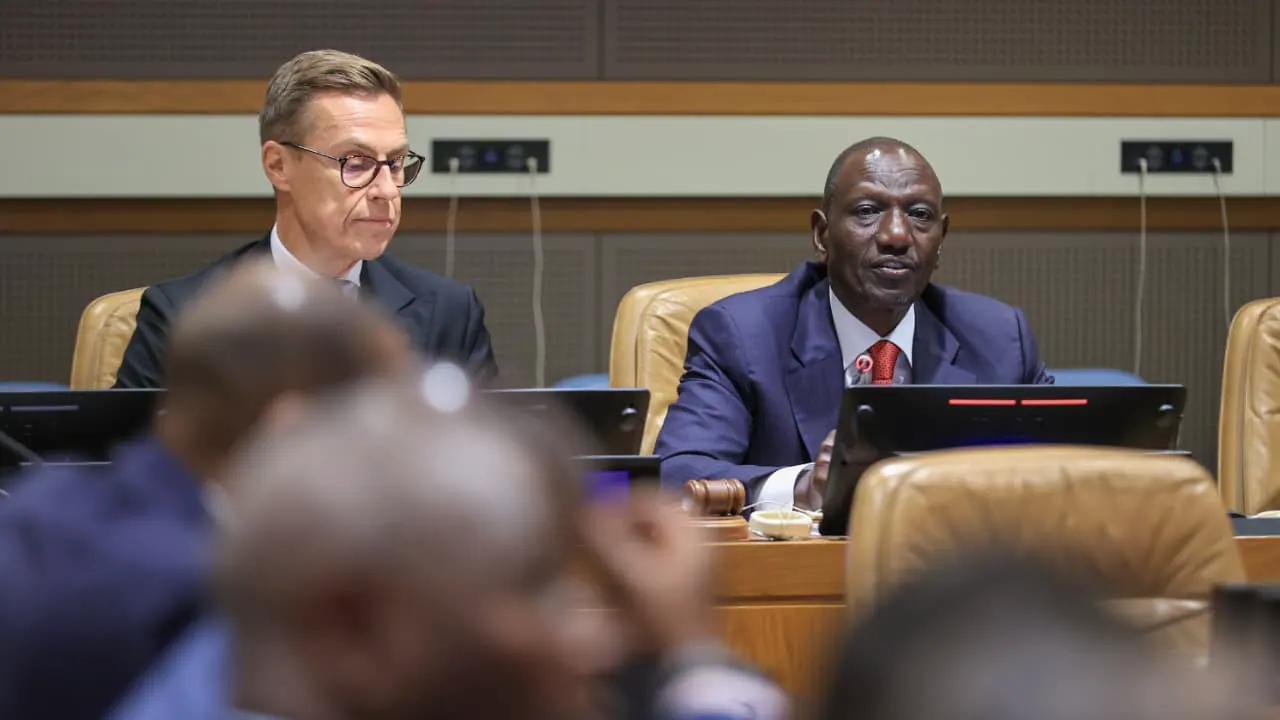
Kenyan President William Ruto has emphasized the need for stronger global cooperation on Artificial Intelligence (AI) to ensure that nations can shape their own future and avoid new forms of technological dependency. Speaking at the High-Level Artificial Intelligence Middle Powers Coalition meeting on the sidelines of the United Nations General Assembly in New York, Ruto advocated for shared sovereignty, where countries pool capabilities at scale while retaining national control where accountability is essential.
Ruto made the remarks while co-chairing the meeting with President Alexander Stubb of Finland. He stressed that political sovereignty without technological agency risks becoming sovereignty in law but dependency in practice. The President added that shared sovereignty is not sovereignty surrendered, but agency enlarged through organized cooperation. This approach, he believes, will enable nations to build the infrastructure, skills, research, and governance capabilities needed for AI systems.
For Africa, President Ruto said the priority is to capture more value created through AI by using the continent's energy, resources, data, and talent to build capabilities, enterprises, and solutions. He warned against the continent reproducing the old extractive economy in digital form, saying Africa cannot provide the minerals, energy, data, content, and talent of the AI revolution and then import the resulting intelligence at a premium. Instead, Africa should focus on building its own AI capabilities.
President Ruto also highlighted Kenya's efforts to pursue this agenda through the National Artificial Intelligence Strategy. The strategy focuses on digital infrastructure, data and AI governance, research, innovation, and commercialization. The President emphasized that Kenya's purpose is practical, aiming to use AI to raise agricultural productivity, strengthen healthcare, expand access to education, improve public services, advance financial inclusion, and create enterprises and jobs.
President Ruto called on the United Nations to remain central to global AI governance. He emphasized that AI governance must be globally shaped, not globally imposed, and that those affected by these technologies must have a meaningful hand in shaping them. The President also proposed that the UN play a key role in ensuring that the rules of the intelligence era are written in a way that is inclusive and representative of all nations.
President Stubb of Finland echoed Ruto's sentiments, noting that nations must have a stake in the development of AI. He emphasized that the technology is too consequential to be left to tech giants alone and proposed that AI be addressed at three levels – companies, governments, and regional regulatory frameworks – while also developing a global system through the United Nations.
The meeting highlighted the importance of international cooperation on AI, with both presidents emphasizing the need for a collaborative approach to ensure that the benefits of AI are shared by all. The High-Level Artificial Intelligence Middle Powers Coalition meeting brought together leaders from various countries to discuss the opportunities and challenges presented by AI and to explore ways to harness its potential for the benefit of all.
Key points
- President Ruto calls for shared sovereignty in AI development to prevent technological dependency.
- Africa must focus on building its own AI capabilities to capture more value created through AI.
- The United Nations should play a central role in global AI governance.