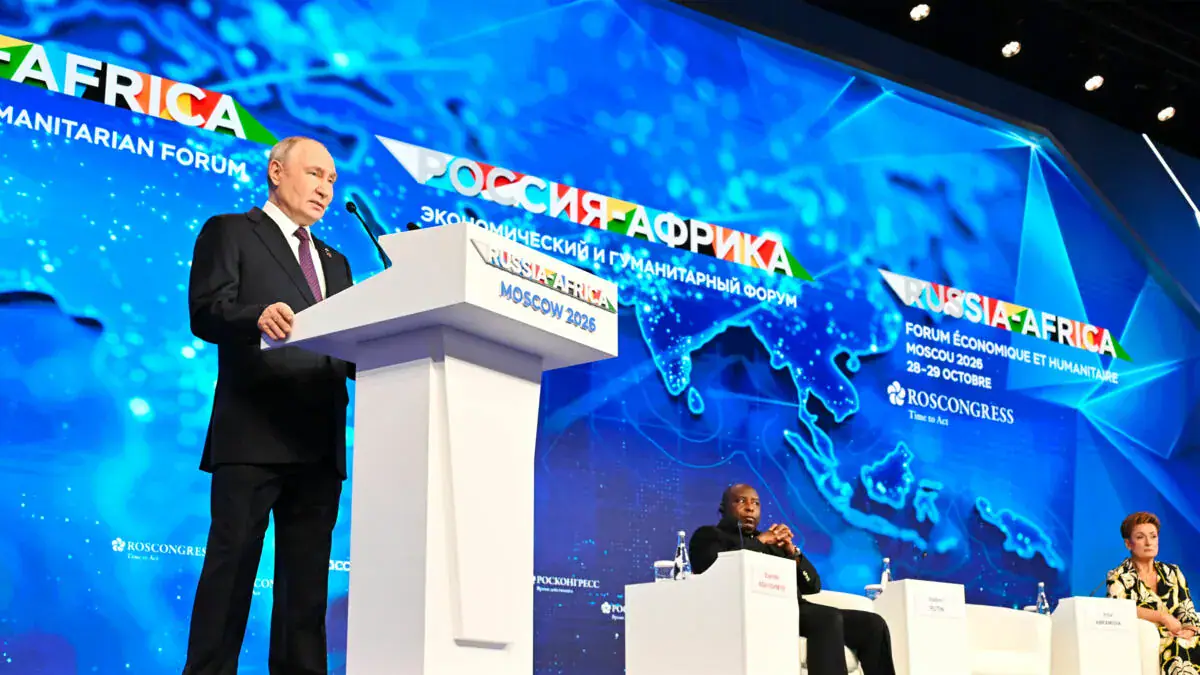
The third Russia-Africa summit commenced in Moscow on Wednesday, with Russian President Vladimir Putin welcoming delegations from 48 African countries. A significant number of these countries were represented by their heads of state or government, including Togo's President of the Council, Faure Essozimna Gnassingbé. The summit aims to strengthen Russia's presence on the African continent, which has become increasingly influential on the global stage.
In his opening address, President Putin described the summit as a demonstration of an ongoing "global transformation." He emphasized that the emergence of a multipolar world is an "objective and irreversible" trend, marking the end of an era where the fate of entire continents was decided by a small group of states. Putin advocated for a greater role for Africa in decision-making at the International Monetary Fund and the World Bank.
Russia's interests in Africa extend to economic and security cooperation. Putin highlighted that Russia supplies grains and fertilizers to over 40 African countries and expressed willingness to increase these deliveries. This move is part of Russia's broader strategy to enhance its influence in Africa, where it competes with the United States, Europe, and China. Africa, with 54 countries, constitutes the largest voting bloc at the United Nations.
Russia's approach to expanding its influence in Africa includes military cooperation. In the Sahel region, countries such as Mali, Burkina Faso, and Niger have turned to Moscow after severing ties with Western partners. Initially, these countries hosted the Wagner group, which has since been replaced by the Africa Corps under the direct command of the Russian Ministry of Defense. Estimates suggest that between 1,700 and 2,000 Russian fighters are present in these countries.
Togo's President Faure Gnassingbé, who arrived in Moscow on Tuesday, has already signed three cooperation agreements with Russian institutions. These agreements cover education, agriculture, culture, and human rights. During the summit, Togo aims to prioritize its interests in food security, energy, education, and the development of its port. The country remains committed to a diversified diplomatic approach, engaging with multiple partners.
The Russia-Africa summit is a follow-up to previous meetings in Sochi in 2019 and St. Petersburg in 2023. It underscores Moscow's intent to solidify its presence on a continent of nearly 1.6 billion people. The summit provides a platform for Russia to engage with African leaders and address issues of mutual interest, including economic cooperation and global governance.
The summit also highlights the geopolitical dynamics at play in Africa. With its large population and growing economic influence, Africa has become a critical player in global affairs. The continent's 54 countries form a significant voting bloc at the United Nations, making it an essential partner for any global power. Russia's engagement with Africa is part of a broader strategy to reshape global politics and challenge the existing international order.
Key points
- Russia's President Vladimir Putin opened the third Russia-Africa summit in Moscow with 48 African countries represented.
- Putin advocates for a greater role for Africa in global decision-making.
- Russia supplies grains and fertilizers to over 40 African countries and is willing to increase deliveries.