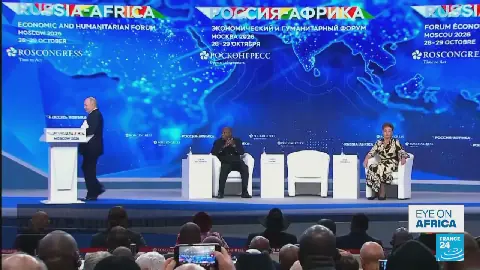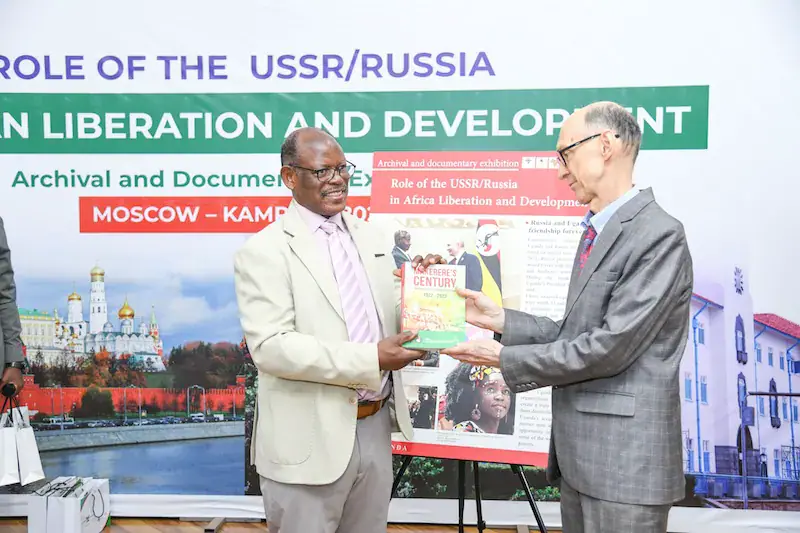
Uganda and Russia are strengthening their bilateral ties, with a focus on education, research, trade, and technology. The two countries are preparing for the third Russia-Africa Summit in Moscow on October 28-29. An exhibition at Makerere University on October 23 explored Uganda's historical ties with Russia and future cooperation opportunities. The event was organized by Makerere University's College of Humanities and Social Sciences and the Russian State University for the Humanities.
Sergey Lobanov, the Russian Chargé d'Affaires in Uganda, said the exhibition was an opportunity to revisit Russia's historical relationship with African countries. He noted that the Soviet Union played a key role in the adoption of the Declaration on the Granting of Independence to Colonial Countries and Peoples 65 years ago. Lobanov described Uganda as a privileged partner and ally of the Russian Federation, with rapidly developing bilateral interaction.
Michael Karugaba, representing the permanent secretary of the ministry of Foreign Affairs, Vincent Waiswa Bagiire, said Uganda's relationship with Russia had evolved from political solidarity during the liberation era to economic transformation cooperation. Karugaba mentioned that Uganda would use the Moscow summit to follow up on areas of cooperation, including investment, energy, and human capital development. He also noted Uganda's admission as a BRICS partner country in January 2025.
Prof Vera Zabotikina, acting vice-rector for International Cooperation at the Russian State University for the Humanities, said the exhibition was part of a project supported by Russia's ministry of Science and Higher Education. Zabotikina highlighted the Soviet Union's role in supporting anti-colonial movements and the adoption of the 1960 United Nations Declaration. She cited examples of Soviet assistance in Uganda, including the construction of an agricultural training institution and medical assistance to Mulago Hospital.
Makerere University vice-chancellor Prof Barnabas Nawangwe emphasized the importance of archival exhibitions in documenting Africa's liberation history. He noted that the Soviet Union supported liberation movements in several African countries, including Uganda, which benefited from Soviet cooperation in science, medicine, and agriculture. Nawangwe called for stronger academic exchanges, collaborative research, and digitization of historical archives.
Mary Frances Atima, chief education officer for Education Standards and Quality Assurance at the ministry of Education and Sports, said education had been a key area of Uganda-Russia cooperation. Atima noted that the Government prioritized human capital development, science, technology, engineering, and mathematics, research, and innovation. She acknowledged the Russian Government's scholarship quota of 50 Ugandan students per academic year and encouraged wider dissemination of information about eligibility requirements.
The exhibition and upcoming summit reflect the growing cooperation and friendly ties between Russia and Uganda. Both countries are committed to strengthening their partnership in various areas, including education, research, trade, and technology. The outcomes of the Russia-Africa Summit are expected to elevate bilateral relations to new heights.
Key points
- - Strengthening cooperation in education, research, trade, and technology - Historical ties between Uganda and Russia - Upcoming Russia-Africa Summit to elevate bilateral relations