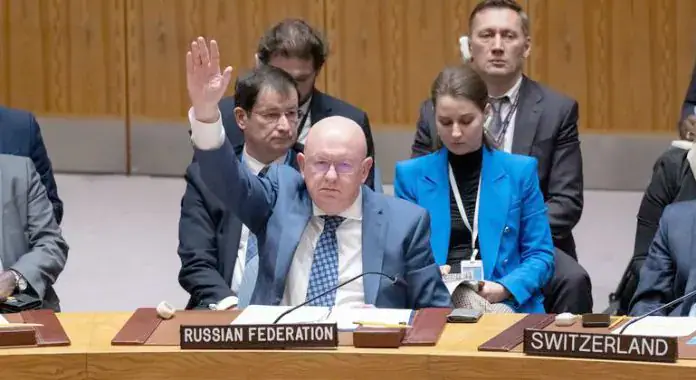
Russia has vetoed a US resolution on Western Sahara, a move that has been hailed as a victory for the Sahrawi people and a setback for Moroccan expansion plans. The resolution, which was rejected by the UN Security Council, would have imposed a solution to the conflict that denied the Sahrawi people's right to self-determination and instead promoted a plan for autonomy under Moroccan sovereignty. The veto has been seen as a significant development in the long-standing conflict.
The Moroccan government had been celebrating the non-renewal of the mandate of the UN Mission for the Referendum in Western Sahara (MINURSO), but the Russian veto has put a damper on those plans. The veto has effectively scuppered Morocco's attempts to impose a solution that would have legitimized its claims to sovereignty over the territory. Instead, the veto has re-emphasized the importance of the Sahrawi people's right to self-determination.
The Algerian government has expressed regret over the non-renewal of the MINURSO mandate, but has welcomed the Russian veto as a victory for international law. In a statement, the Algerian foreign ministry said that the veto had prevented a biased resolution from being adopted, one that would have legitimized Morocco's occupation of the territory. The ministry also criticized the US resolution for failing to prioritize the Sahrawi people's right to self-determination.
The Russian veto has been hailed as a significant development by many experts, who see it as a reaffirmation of the importance of international law. Ahmed Mizab, an analyst, said that the veto had allowed the Western Sahara question to be recontextualized as a matter of decolonization and self-determination. He added that the veto had ensured that any solution to the conflict would have to prioritize the Sahrawi people's right to self-determination.
The Algerian government has long been a supporter of the Sahrawi people's right to self-determination, and has been critical of Moroccan attempts to impose a solution to the conflict. In a letter to the UN Security Council, Algerian Foreign Minister Amar Bendjama warned that any attempt to impose a solution that bypassed the Sahrawi people's right to self-determination would be a serious deviation from international law.
The UN Security Council has been discussing the Western Sahara conflict for many years, with no resolution in sight. The Russian veto has effectively reset the debate, emphasizing the need for a solution that prioritizes the Sahrawi people's right to self-determination. The veto has also highlighted the need for a more nuanced approach to the conflict, one that takes into account the competing claims and interests of the parties involved.
The Western Sahara conflict has been a long-standing issue, with Morocco claiming sovereignty over the territory and the Sahrawi people demanding self-determination. The conflict has led to a protracted refugee crisis, with many Sahrawis living in refugee camps in Algeria. A solution to the conflict that prioritizes the Sahrawi people's right to self-determination is seen as essential to bringing peace and stability to the region.
Key points
- The Russian veto has dealt a blow to Moroccan plans for autonomy under Moroccan sovereignty in Western Sahara.
- The veto has re-emphasized the importance of the Sahrawi people's right to self-determination.
- The Algerian government has welcomed the Russian veto as a victory for international law.