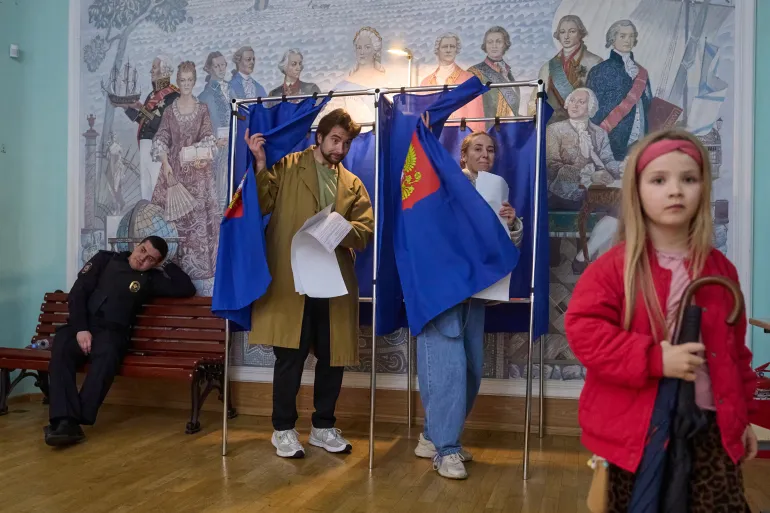
Russia's parliamentary elections, which concluded on Sunday, have yielded early results indicating that President Vladimir Putin's United Russia party is poised to maintain its hold on the lower house of parliament, the State Duma. The election, which began on Friday, was widely predicted to see United Russia dominate the vote amid a tightly controlled electoral process. Despite this, the Kremlin framed the vote as an opportunity for residents to express their opinions, particularly in the context of the ongoing economic hardship and the war in Ukraine.
The elections saw a voter turnout of just below 57%, with over 3.6 million people voting online, including residents of four Ukrainian regions that Moscow illegally annexed in 2022 – Donetsk, Luhansk, Kherson, and Zaporizhzhia – as well as those in Crimea, which was taken in 2014. However, the United Nations and most of the world do not recognise Crimea and other occupied Ukrainian regions as part of Russia. The online voting process was facilitated by the Ministry of Digital Development, Communications and Mass Media.
The Central Election Commission (CEC) reported that, as of Sunday night, 90.43% of ballots had been counted. According to the CEC, United Russia led with 57.86% of the vote, with 225 deputies apportioned from party lists. In single-seat races, another 225 lawmakers will be chosen, and Putin's party is also projected to win most of them. The party's dominance was not surprising, given the limited opposition to Putin's policies.
Other parties, such as the Communist Party of the Russian Federation (CPRF), the ultranationalist Liberal Democratic Party of Russia (LDPR), New People, and A Just Russia, trailed behind in the early election results but were still on course to win seats in the State Duma. The vote breakdown showed the CPRF at 13.84%, the LDPR at 8.9%, New People at 7.94%, and A Just Russia at 4.95%. Despite their lower vote shares, these parties largely vote in line with United Russia in parliament.
The Berlin-based think tank NEST, co-founded by Kremlin critic Mikhail Khodorkovsky, noted that the vote could produce awkward moments for the Kremlin at a time of economic strain. NEST suggested that the votes received by the CPRF and New People might represent a silent protest against Putin and United Russia, even if these parties do not directly challenge the president.
Some opposition candidates, particularly those from the liberal Yabloko party, expressed concerns about their freedom and safety. Yabloko's leader, Nikolai Rybakov, spoiled his ballot paper by writing his party's name and the slogan "For peace". This act was seen as a form of protest against the war in Ukraine and the Kremlin's policies.
The election results are likely to have implications for Russia's domestic and foreign policy. With United Russia expected to maintain its majority in the State Duma, Putin's government is likely to continue its current trajectory. However, the votes for other parties may indicate growing dissent and frustration among some segments of the Russian population.
Key points
- United Russia party wins 57.86% of the vote, with 225 deputies apportioned from party lists.
- The election saw a voter turnout of just below 57%, with over 3.6 million people voting online.
- Other parties, such as the CPRF and LDPR, trailed behind but were still on course to win seats in the State Duma.