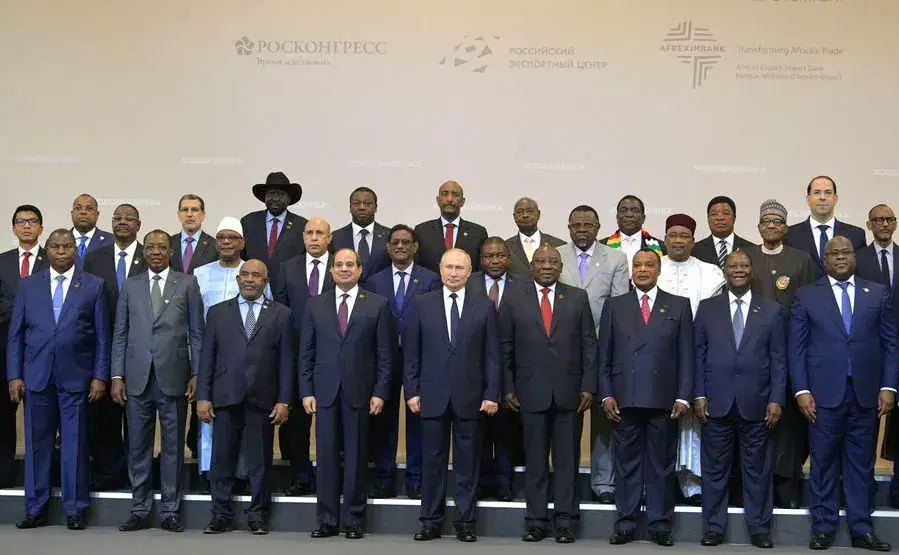
The Third Russia-Africa Summit and Economic and Humanitarian Forum has commenced in Moscow, with at least 17 African heads of state in attendance. The agenda encompasses security, energy, infrastructure, finance, and humanitarian cooperation. The economic challenge lies in transitioning a relationship based on commodities to one focused on production. In 2025, trade turnover between Russia and Africa exceeded $27 billion, driven by Russian grain, fertilizers, energy, and metals, while Africa exported coffee, cocoa, tea, fruit, and minerals.
Russia supplies fertilizers to 21 African nations, with South Africa being a significant market, where fertilizers account for over two-thirds of Russian supplies, valued at approximately $908 million. However, these figures also highlight a ceiling, as selling commodities does not lead to sustainable development. African governments are increasingly seeking greater control over resources, longer value chains, and local processing. The African Continental Free Trade Area (AfCFTA) aims to boost intra-African trade, which reached $220 billion in 2025.
Despite the progress, intra-African trade remains limited, accounting for only 15 to 18 percent of the continent's commerce, compared to over 60 percent in Europe. Poor infrastructure, high logistics costs, and fragmented regulation hinder the growth of intra-African trade. To overcome these challenges, Africa and Russia are exploring areas for partnership that can produce lasting returns. Agricultural processing and storage are identified as key areas, with Ethiopia being a potential candidate for investments in milling, edible oils, and animal feed.
Energy is another sector where Russia and Africa can collaborate, with Rosatom building the 4,800 MW El Dabaa nuclear plant in Egypt and exploring lithium and uranium projects in Mali and Tanzania. Servicing and maintenance of industrial and energy equipment are also seen as promising areas for cooperation, as they build on existing capabilities rather than starting from scratch. South Africa's experience in this area is cited as a positive example.
The pharmaceutical sector is another potential area for collaboration, provided Russian producers participate in joint procurement schemes that pool demand across countries. However, localization is not a panacea, and options for cooperation range from exporting equipment with technical support to local assembly and joint production. Zambia's mining supply chain highlights the challenges of local firms competing with foreign suppliers due to electricity shortages and lack of long-term capital.
Finance remains a significant hurdle for Russia-Africa cooperation, with Russia's Economic Development Ministry offering concessional lending of up to $100 million per project. However, commentators argue that Moscow still needs to develop financial mechanisms to support its investments across Africa. Multilateral lenders such as the New Development Bank and Afreximbank are seen as necessary partners for capital-intensive projects.
Skills development is crucial for the success of Russia-Africa cooperation, with about 37,000 African students currently studying at Russian universities. The planned Russian-African Network University and branch campuses of Russian universities could help address the skills gap, provided training is tied to real jobs. The summit is expected to move toward a new action plan for 2027-2029, which will need to convert broad priorities into bankable projects with identified customers, financing, and clear risk allocation.
Key points
- Russia and Africa aim to shift from commodity sales to processing, servicing, and skills development.
- The partnership faces challenges, including poor infrastructure, high logistics costs, and limited access to finance.
- The success of the partnership will depend on converting broad priorities into bankable projects with identified customers, financing, and clear risk allocation.