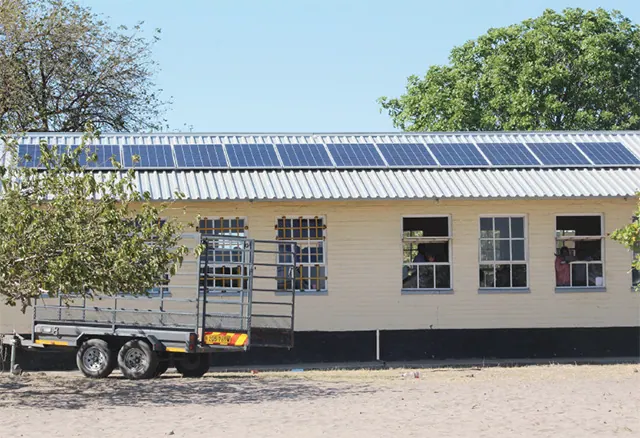
Deputy Minister of Industries, Mines and Energy Gaudentia Kröhne has encouraged rural communities in Namibia not to view solar electricity as a second-class solution. Speaking at the 29th annual Tulikongwe Cultural Festival in the Zambezi region, Kröhne emphasized that solar electricity can provide essential services such as lighting, phone charging, and refrigeration. She noted that many rural households are scattered far from the national grid, making it costly to extend power lines.
The Mashi Traditional Authority, led by Chief Mfumu Mayuni III, hosted the cultural festival under the theme 'Ku sileleza chizo chetu', which translates to 'protecting our culture'. Kröhne highlighted that a properly designed solar home system or community mini-grid can offer many of the same services as grid electricity. She added that solar electricity can often provide these services sooner and at a lower infrastructure cost than extending the national grid.
Kröhne emphasized that the government has a long road ahead in its ambition to provide every Namibian with access to modern electricity services by 2040. To address this, the government has allocated N$250 million from the treasury and a further N$10 million through the National Energy Fund for the 2026/27 electrification programme. This programme aims to increase access to electricity in rural areas.
The government has also allocated N$10 million for service connections in four conservancy areas in the Zambezi region, with N$2.5 million allocated to the Mashi component. Kröhne assured that the Mashi people will not be treated as invisible and that the current project will be followed through. She added that the wider programme will be developed using both grid and solar solutions according to the needs of each locality.
Chief Mfumu Mayuni III noted that while rural communities are living in the modern age, electricity is still a luxury in many rural households. He called on the government to make rural electricity a basic service, enabling people to charge their phones and power radios. Mayuni emphasized that electricity is essential for accessing cellular phones and radio power in the information age.
Mayuni also highlighted that the establishment of business enterprises in rural areas is dependent on electricity supply for manufacturing processes. He urged the government to prioritize rural electrification to support economic development. Kröhne's call for rural communities to consider solar electricity as a viable option was echoed by Mayuni's sentiments.
The government's efforts to increase access to electricity in rural areas are ongoing, with a focus on both grid and solar solutions. Kröhne's visit to the Tulikongwe Cultural Festival provided an opportunity for her to engage with rural communities and encourage them to consider solar electricity as a viable option. The festival provided a platform for the government to showcase its initiatives aimed at addressing the energy needs of rural communities.
Key points
- The Namibian government has allocated N$260 million for the 2026/27 electrification programme to increase access to electricity in rural areas.
- Deputy Minister Kröhne encouraged rural communities to consider solar electricity as a viable option for powering their homes and businesses.
- Chief Mfumu Mayuni III called on the government to make rural electricity a basic service to support economic development and access to modern services.