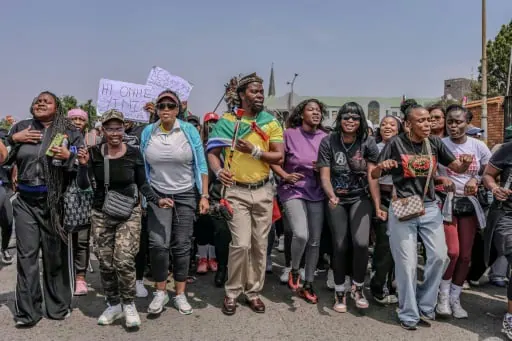
Hundreds of runners gathered in Kempton Park, near Johannesburg, on Saturday to protest the recent murders of nine women in the district. The body of 38-year-old Elizabeth Moselakgomo, a local resident and mother of an eight-year-old daughter, was found earlier this month. Moselakgomo was last seen alive on September 9, when she left to go running, and her body was discovered three days later. The runners, from several local running clubs, covered 13 kilometers as part of their protest.
The Kempton Park district has seen a surge in violence against women, with nine murders reported between July 15 and mid-September. This has sparked growing fear and anger across the country, with ordinary people gathering in several cities to honor the memory of the victims and call for action. South Africa has one of the highest murder rates globally, with an average of more than 60 murders per day. The recent string of killings has raised concerns that a serial killer or group of killers may be operating in the area.
The discovery of the women's bodies, some of which were partially naked and battered, has added to the fears. Investigators have established that some of the women were not killed where their bodies were discovered, but have refused to commit to a theory of a serial killer or group of killers. According to the United Nations, one in three women in South Africa experience physical or sexual violence during their lifetime, and the government has described the levels of gender-based violence as a national disaster.
The protest in Kempton Park was attended by runners of all ages, including 47-year-old Hlompho Matji, who said she lived in the same neighborhood as the victim. Matji expressed her concerns about the safety of local residents, saying, "We shouldn't be looking at our back. We should be protected at all times. We want to reclaim our streets." Busisiwe Pakati, a 53-year-old software engineer, also participated in the protest, saying that the violence was "taking away our freedom, taking away our confidence."
The protest was not limited to Kempton Park, with over a thousand students holding a vigil at the University of Cape Town on Friday evening. The students, who carried placards reading "I want to live, not survive," expressed their outrage at the recent killings and called for action from the government. Kitso Mojapelo, a student leader, said that the continued silence from the government was unacceptable, and that "enough is enough."
The area where Moselakgomo's body was found is a popular spot for jogging, but it is now a site of great sadness for local residents. A few extinguished candles and a bouquet of flowers marked the spot where she was found, along a discreet driveway squeezed between a highway and a concrete wall behind a hotel. Moselakgomo will be buried in the small town of Phake, in northeastern Mpumalanga province, on Sunday.
The recent murders have highlighted the need for urgent action to address the issue of violence against women in South Africa. The government has been criticized for its response to the crisis, with many calling for more to be done to protect women and bring perpetrators to justice. As the country continues to grapple with this issue, the protests in Kempton Park and Cape Town serve as a reminder of the need for collective action to bring about change.
Key points
- Nine women have been murdered in the Kempton Park district of South Africa in the past two months, sparking widespread outrage and protests.
- The murders have raised concerns about the safety of women in South Africa, where one in three women experience physical or sexual violence during their lifetime.
- Protests have been held in Kempton Park and Cape Town, with hundreds of runners and over a thousand students calling for an end to the violence and action from the government.