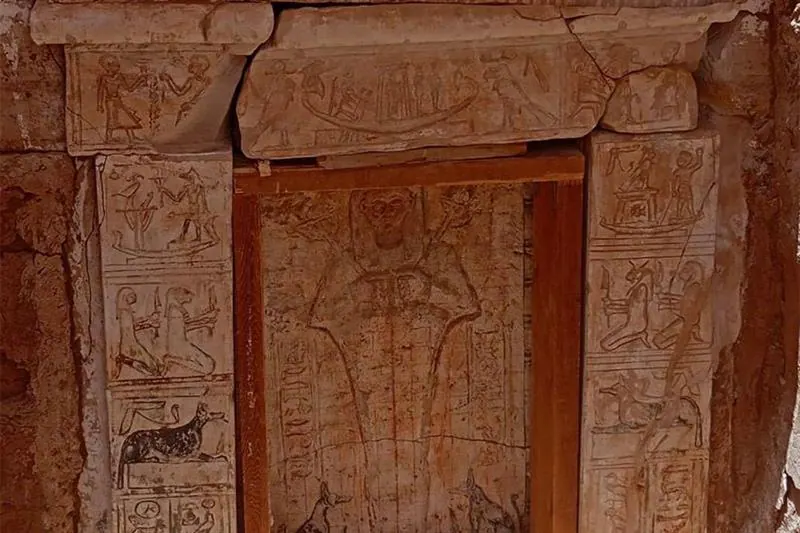
An Egyptian archaeological mission has made a significant discovery at the Bir Al-Shaghala archaeological site in the Dakhla Oasis. The team has unearthed a distinctive pyramidal-shaped tomb dating back to the Roman period. The tomb, built of mudbrick, is believed to have been used to bury a man and his wife. Its unusual architectural design and mix of Egyptian, Greek, and Roman elements offer new insights into funerary practices and cultural life in the Dakhla Oasis during the Roman period.
The tomb features a rare stone entrance, which is decorated with sunk-relief hieroglyphic inscriptions containing funerary spells and protective recitations. The entrance is topped with an Egyptian cornice decorated with a winged sun disk and two cobras, followed by an architectural element resembling a bundle of reeds. A 14-step staircase leads to the sandstone entrance, which is built in the Egyptian architectural style. The lintel bears a rare funerary scene depicting the seventh hour of the Imy-Duat, one of the ancient Egyptian Books of the Netherworld.
One of the most notable finds is a stone funerary stele bearing a lament written in Ancient Greek. The 19-line text is dedicated to a man named Pisechtes, who preliminary studies suggest may have served as a judge. Dating to the late third or early fourth century AD, the inscription offers evidence of the literary and cultural activity that flourished in the oasis during the Roman period. This discovery provides valuable information about the cultural and religious life of the Dakhla Oasis during that time.
The excavation also uncovered a sandstone offering table positioned above a sandstone purification basin, a collection of pottery vessels, and a bronze coin bearing a relief depiction of the Roman Emperor Constantine. Archaeologists also found evidence suggesting the tomb may have been reused later. A mudbrick chapel was discovered above the main entrance, with a funerary shrine in front of it consisting of four square mudbrick columns. These findings indicate the tomb's significance and the possibility of later use.
The Bir Al-Shaghala site is one of the major archaeological areas in the Dakhla Oasis and forms part of the necropolis of the ancient city of Mut, the oasis capital during the Ptolemaic and Roman periods. The Supreme Council of Antiquities began excavations at the site in 2002, and successive seasons have revealed numerous tombs with diverse architectural designs. The tombs reflect a distinctive blend of ancient Egyptian traditions with Greek and Roman influences.
Sherif Fathy, Minister of Tourism and Antiquities, said the discovery highlights the archaeological and cultural diversity of Egypt’s oases and the evidence they preserve of the civilizations that succeeded one another in Egypt. He stressed the importance of supporting Egyptian archaeological missions and their work to uncover new evidence that helps us understand Egypt’s history across different periods. This discovery is a significant addition to Egypt's rich cultural heritage.
The tomb’s architectural features, inscriptions, and funerary texts provide important information about funerary practices and the cultural and religious life of the Dakhla Oasis during the Roman period. Hisham El-Leithy, Secretary-General of the SCA, emphasized the significance of this find, which sheds new light on the history of the Dakhla Oasis. The discovery is a valuable contribution to our understanding of ancient Egyptian culture and its interactions with other civilizations.
Key points
- The tomb's unique blend of Egyptian, Greek, and Roman elements reflects the cultural diversity of the Dakhla Oasis during the Roman period.
- The discovery of the stone funerary stele with a lament written in Ancient Greek provides evidence of the literary and cultural activity in the oasis during that time.
- The tomb's architectural design and findings suggest it may have been used to bury a high-ranking individual, possibly a judge named Pisechtes.