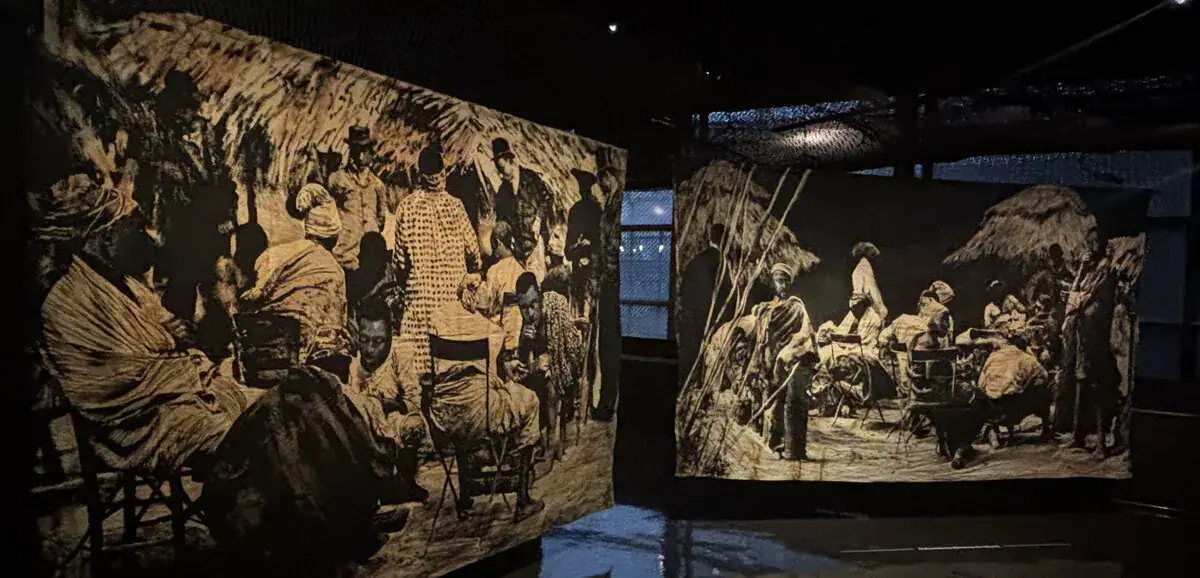
The Musée du Quai Branly–Jacques Chirac in Paris is hosting the exhibition "Violence Silencieuse" by French-Beninese artist Roméo Mivekannin, which opened on November 10, 2026. The exhibition features ironwork birdcages and paintings inspired by photographs of human zoos, prompting reflection on the role of museums during colonial times and beyond. Mivekannin's work critiques the legacy of colonialism and the concept of universalism in museums.
The exhibition's centerpiece includes four ironwork birdcages suspended in the first gallery, each representing a different institution: the Musée d'Ethnographie du Trocadéro, the Musée de l'Homme, the Palais de la Porte Dorée, and the Musée du Quai Branly itself. Mivekannin views these cages as symbols of confinement, where objects and people are trapped without the possibility of escape.
To access the exhibition, visitors walk along a path lined with objects from the museum's permanent collection, acquired from Africa, Asia, Oceania, and the Americas since the 18th century. These items have passed through various institutions, including the Louvre and the Musée d'Ethnographie du Trocadéro, before arriving at the Musée du Quai Branly. The artist questions the role of these institutions during colonial times and the notion of universalism.
The debate over the restitution of cultural artifacts taken during the colonial period is echoed in Mivekannin's work. Some argue that these items are inalienable public property, while others claim they should be returned to their countries of origin. A 2026 law allows for the restitution of certain cultural artifacts by decree, with some exceptions.
The second part of the exhibition features 14 paintings created from old fabrics and acrylic paint, reproducing photographs from the museum's archives. These images document "human zoos" organized in Paris during the 19th and 20th centuries, where people were exhibited in inhumane conditions. Mivekannin's work highlights the silenced violence and suffering of those exhibited.
The paintings also feature Mivekannin's own face, blending into the scenes or looking directly at the viewer, as a witness from the present. The exhibition aims to raise awareness about the lasting impact of colonialism on our visual vocabulary and collective memory.
The exhibition "Violence Silencieuse" will run at the Musée du Quai Branly–Jacques Chirac until April 4, 2027.
Key points
- Roméo Mivekannin's exhibition critiques the colonial legacy of museums and the concept of universalism.
- The exhibition features ironwork birdcages and paintings inspired by photographs of human zoos.
- The show prompts reflection on the restitution of cultural artifacts taken during the colonial period.