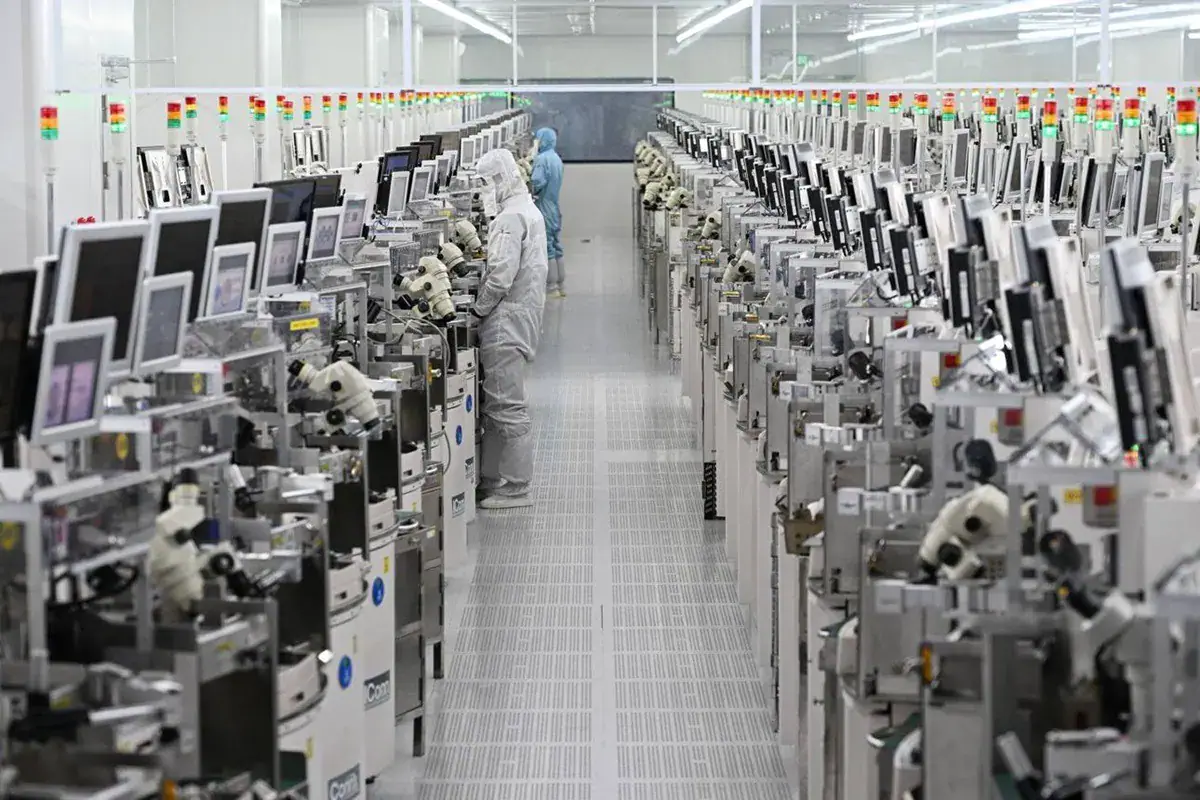
China's semiconductor export earnings have more than doubled this year, despite a minimal increase in the number of integrated circuits shipped overseas. According to figures released by China's General Administration of Customs on November 10, semiconductor exports increased 111.1% in US dollar terms between January and October. In contrast, the physical volume of integrated circuits exported grew by only 3.2%. This unusual gap is emerging as one of the strongest signals of how global investment in artificial intelligence is changing the value of Chinese exports.
China's cumulative trade surplus reached $1.04 trillion, surpassing the trillion-dollar mark for a second consecutive year and reaching it one month earlier than in 2025. October exports rose 35.2% from a year earlier to approximately $412.3 billion, exceeding the 33.5% growth forecast by economists surveyed by Reuters. Imports increased even faster, climbing 41.6% to $307.1 billion. China has benefited from strong international demand for electronics, computing equipment, and industrial products, particularly as technology companies commit enormous sums to building AI infrastructure.
The export figures also expose a more complicated economic position. Chinese manufacturers are earning more from overseas customers while domestic consumption remains subdued, the property market continues to weigh on household confidence, and major trading partners are taking measures to protect their industries. For an economy already heavily dependent on manufacturing exports, the challenge is sustaining that growth without becoming more vulnerable to changes in global technology spending and trade policy.
Chip export earnings are rising far faster than shipments. China exported approximately 302.03 billion integrated circuits between January and October, an increase of 3.2% from the corresponding period of 2025. Their total export value rose 111.1% in dollar terms, implying an increase of approximately 105% in average declared export value per circuit. Such a difference cannot be explained by shipment volumes alone.
Manufacturers may be exporting more expensive components, receiving higher prices for certain products, or benefiting from changes in the composition of international demand. An increase in average export value does not necessarily mean that an identical chip has become twice as expensive. Integrated circuits encompass components with vastly different capabilities and prices, ranging from relatively inexpensive chips used in everyday electronics to sophisticated memory and processing components found in advanced computing equipment.
October's figures show how substantial the change has become. China exported integrated circuits worth approximately $39.59 billion during the month, an increase of 137.1% from October 2025. Global investment in AI infrastructure has contributed to that momentum, particularly through demand for memory, computing equipment, and other components used in data centres. A shortage of memory chips linked to the expansion of AI infrastructure has also supported higher prices in parts of the semiconductor market.
China's participation in semiconductor supply chains also remains dependent on international trade in both directions. Customs figures show that the country imported approximately 525.75 billion integrated circuits during the first ten months, an increase of 6.5% from a year earlier. That is substantially more units than China exported, although the figures do not compare equivalent types of chips or establish the relative values of those imports and exports.
Key points
- China's semiconductor export value surged 111.1% in the first ten months of 2026.
- Integrated-circuit shipment volumes rose only 3.2% during the same period.
- China's cumulative trade surplus reached $1.04 trillion.