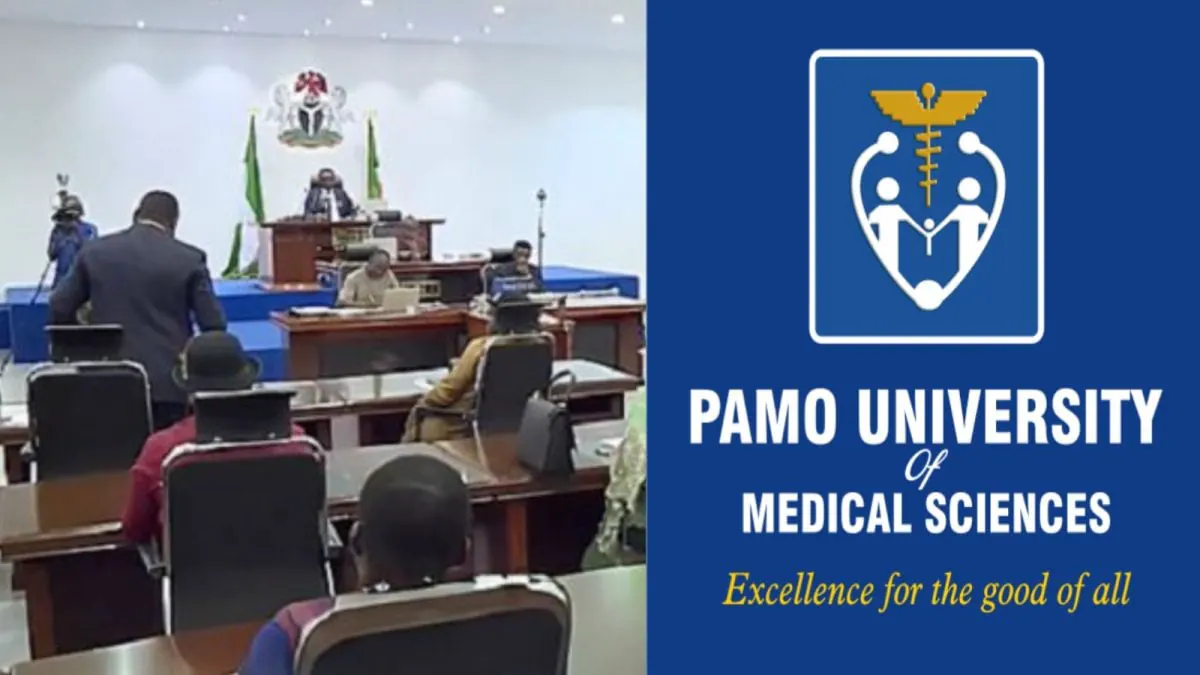
The Rivers State House of Assembly has directed the arrest of the Vice-Chancellor of PAMO University of Medical Sciences, following his failure to appear before a committee probing the university's financial dealings with the state government. The committee, led by Deputy Speaker Dumle Maol, had invited the Vice-Chancellor to explain how funds released to the university under the state's scholarship programme were utilised. The Vice-Chancellor's absence led to the lawmakers' decision to invoke their constitutional powers.
The investigation covers funds released to PAMO University over several years, particularly money provided by the state government to support Rivers indigenes studying at the institution. The Assembly had become concerned about the funding arrangement after removing a proposed N6 billion allocation for PAMO University from the 2026 Rivers State budget. A seven-member ad hoc committee was set up to probe the financial relationship between the state government and the university.
The committee was mandated to establish the total amount released to the institution since 2017, determine how the funds were spent, and identify beneficiaries of the scholarship scheme. The House had earlier stated that the investigation was necessary before further public funds could be committed to the university. The committee subsequently invited the Vice-Chancellor and other officials to provide documents and explanations relating to the disbursements.
The disagreement between the Assembly and the university management became more pronounced after lawyers representing PAMO University appeared before the committee instead of the Vice-Chancellor. The university's counsel, Chukwuma Chinwo, questioned the Assembly's jurisdiction over the institution and argued that the lawmakers could not compel the Vice-Chancellor to appear. The Assembly, however, maintained that the funds under investigation were public resources and that it had a constitutional responsibility to establish how they were used.
According to the committee, records obtained from the state Ministries of Finance and Education raised questions over the amount released to PAMO University and the corresponding number of students said to have benefited from the scholarship programme. The committee also raised concerns over discrepancies in documents presented by government agencies. Speaker Martin Amaewhule acknowledged that the scholarship programme was designed with a good intention but expressed concern over the way the scheme was implemented.
The Speaker claimed that records before the Assembly indicated that more than N29 billion had been released to PAMO University, while only about N5 billion could be accounted for as utilised. The Assembly has recommended that the Rivers State Government establish a committee to recover any funds found to be unaccounted for and return such money to the state's Consolidated Revenue Account. The lawmakers are also seeking clearer records of the students covered by the scholarship arrangement and the amounts spent on their education.
The committee's investigation was initially scheduled to be concluded with a report to the House on or before September 30. The Assembly's decision to order the Vice-Chancellor's arrest marks an escalation in the dispute between the Assembly and the management of the privately owned university, which was founded by former Rivers State Governor, Peter Odili. The investigation is ongoing, with the Assembly seeking to establish the facts surrounding the funding of PAMO University.
Key points
- The Rivers State House of Assembly has ordered the arrest of the Vice-Chancellor of PAMO University of Medical Sciences for failing to appear before a committee investigating billions of naira released to the institution.
- The investigation covers funds released to PAMO University over several years, particularly money provided by the state government to support Rivers indigenes studying at the institution.
- The Assembly has recommended that the Rivers State Government establish a committee to recover any funds found to be unaccounted for and return such money to the state's Consolidated Revenue Account.