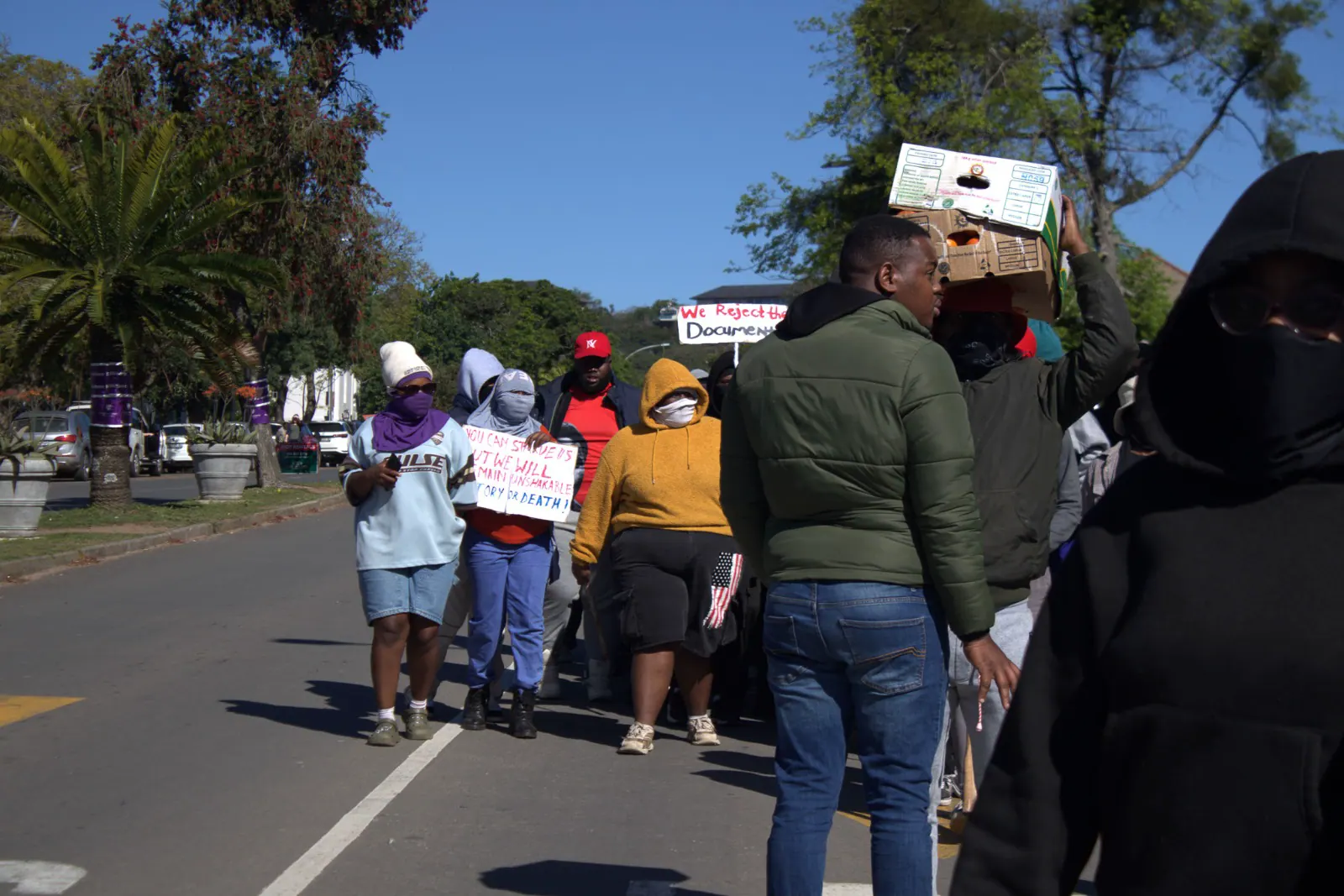
Students at Rhodes University in South Africa are exploring alternative ways to express their discontent with the institution's proposed fee structure after a court interdict restricted their protest actions. On Wednesday, the Eastern Cape High Court in Makhanda granted Rhodes University an interim interdict, preventing students from continuing protest action until the matter returns to court on 27 October. The interdict was issued after students blockaded all entrances to the university on Tuesday and Wednesday.
The Student Representative Council (SRC) president, Thalethu Magidela, addressed a gathering of students in front of the Rhodes Business School, advising them that they could not protest until 27 October without risking arrest. SRC member Keketso Dibakwana sought to calm the students, emphasizing that the SRC's primary focus was to protect the student body. The students had been protesting against the university's proposed fee structure, which they claim is unfair and could lead to financial hardship.
During the gathering, students discussed possible ways to continue their protest without contravening the court order. One suggestion was for the SRC to resign, allowing the students to hold a meeting without being bound by the SRC's authority. Another idea was to approach the Makana Local Municipality for permission to hold a silent protest off campus. Students believed that obtaining a permit could take as little as two hours, and they could then organize a protest in Makhanda.
The SRC has secured some concessions from the university after meeting with the leadership on Wednesday evening. According to a statement released by the SRC, the university has welcomed an inverted sliding scale with a means test, which would see students with more debt paying less, while those with smaller debt would pay 50%. However, the university cited legal provisions that prevent it from implementing a means test and agreed to revisit the issue.
The SRC and university management also discussed other demands, including the R25 000 threshold debt that prohibits students from returning to residence. The university agreed to consider alternative amounts, including the R75 000 proposed by student leaders. Additionally, the university agreed to release June results regardless of debt from 2027, a demand made by the SRC.
Student leaders also rejected a blanket R3 000 monthly payment, and the university tasked them with coming up with a feasible amount. Furthermore, the SRC maintained its demand for a 15% debt settlement discount, while the university indicated a willingness to consider debt credits of R1 000–R5 000 per distinction. The parties agreed to revisit these issues.
The SRC and university management are set to continue negotiations, with a court date scheduled for 27 October. The students' protests have highlighted the ongoing challenges faced by students in South Africa, where many struggle to afford tertiary education. The outcome of the negotiations and court proceedings will likely have significant implications for Rhodes University students and the broader higher education sector.
Key points
- Rhodes University students are exploring off-campus protest options after a court interdict restricted their actions.
- The SRC has secured some concessions from the university, including an inverted sliding scale with a means test.
- The parties are set to continue negotiations, with a court date scheduled for 27 October.