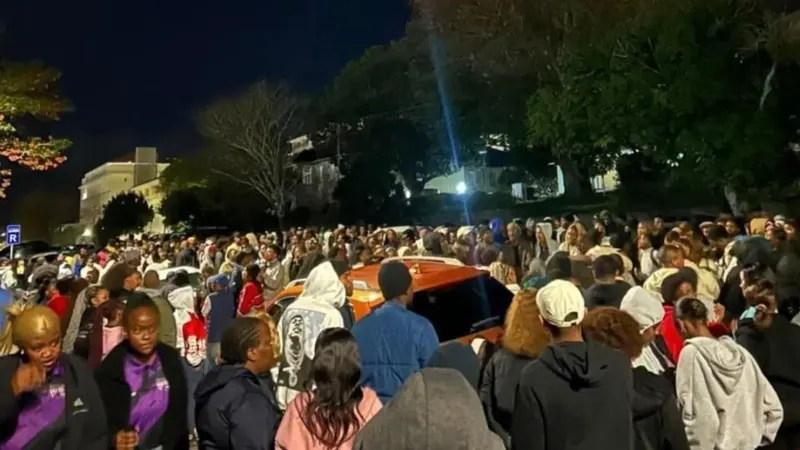
Students at Rhodes University in Makhanda, South Africa, blocked the entrances to the campus on Tuesday in protest over a new plan to recover student debt. The protest is against the 2027 protocol on the payment of student fees, which the university council approved to deal with outstanding student debt and protect the university's long-term finances. The students' representative council and student representatives had raised their objections to the protocol with university leadership on Monday night.
The university spokesperson, Olwethu Gwanya, confirmed that the next council meeting would be in December, and said the council would consider the students' concerns rather than simply sign off on them. Gwanya stated that the university leadership could not just take decisions overnight and that the concerns raised by the students should be discussed in council and agreed upon or approved by council. The students' protest comes as they object to the new protocol.
According to Gwanya, the protocol applies to students who pay their own fees, and not to those funded by the National Student Financial Aid Scheme. The protocol is a way for the university to assist students who cannot pay fees. Gwanya also mentioned that there was an issue with NSFAS, which left many students in limbo when it comes to fees. The university is trying to find a solution to help these students.
A post circulated among students on social media claimed that the protocol required students to pay 50% of their outstanding debt by the end of October and an initial fee of more than R30,000 by January 15, 2027, or they would not be allowed back next year. The post also claimed that residence fees would rise to about R100,000 a year. However, a Rhodes University residence fee schedule seen by IOL lists its residences at R92,851 and R97,482 a year.
NSFAS caps accommodation funding at R52,000 a year for students in metros and about R43,000 for students elsewhere, according to Parliament's portfolio committee on higher education. This highlights the challenges students face in paying for their accommodation and fees. The university's new protocol has added to the concerns of students who are already struggling to pay for their education.
Despite the protest, Gwanya said that there was no commotion or chaos on campus, and staff who could work remotely had been told to do so, while essential services staff who were able to get to campus were at work. The university also postponed the memorial service for its former registrar, Prof Adele Moodly, to a date still to be set. The university is trying to minimize the disruption caused by the protest.
The students will have to wait until December for the university council to consider their demands. The council will discuss the students' concerns and make a decision on the protocol. The outcome will determine the future of the students' fees and debt recovery plan. The university and students are hoping for a resolution that will benefit all parties involved.
Key points
- Students at Rhodes University protest a new debt recovery plan that they claim requires them to pay 50% of their outstanding debt by the end of October.
- The university council will consider the students' concerns in December.
- The protocol applies to students who pay their own fees, and not to those funded by NSFAS.