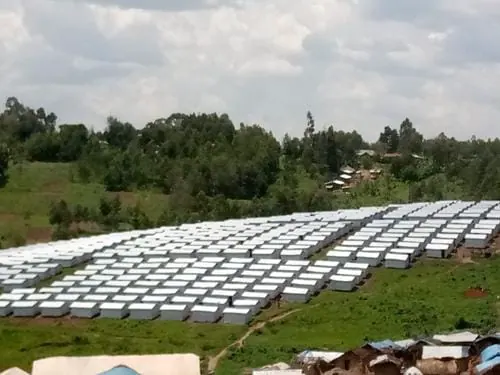
The return of displaced persons to Bule, a locality in Djugu territory, Ituri Province, Democratic Republic of the Congo, has been slow. Several months after the area was recaptured by the FARDC from the CRP, fear and explosive remnants of war continue to prevent families from leaving the Plaine Savo displacement site. According to the military governor, General Major Gaby Kasongo Mulumba, who visited Bule on August 11, 2026, the displaced persons were encouraged to return to their homes and report any threats.
As of mid-September 2026, only a few households from Plaine Savo had returned to their villages, with many still commuting between Bule and the displacement site. The main obstacle to their return is the presence of explosive remnants of war discovered in several villages. Protection actors are calling for demining operations and population awareness campaigns. The situation at Plaine Savo remains precarious, with approximately 76,000 people living in difficult conditions, with limited access to water, food, and healthcare.
The site of Plaine Savo is overcrowded, and the situation is further complicated by the presence of three confirmed Ebola cases, which have been detected and treated at the Fataki hospital. For these families, returning to Bule offers the hope of finding their homes, fields, and commercial activities. However, the lack of security and basic services remains a major concern. The MONUSCO mission is accompanying the process with joint patrols with the FARDC in Bule and Fataki.
On August 26, 2026, the MONUSCO Force Commander, Lieutenant General Ulisses de Mesquita Gomes, visited the area to reassure the population. Although some inhabitants have started to frequent their fields again, this is not enough to guarantee their safe return. The civil society has reported the absence of police in five localities in Djugu, including Bule. Without local police, security of the axes, and basic services, the return of displaced persons cannot be sustainable.
Bule was recaptured by the FARDC on January 16, 2026, after over a month of occupation by the CRP. A first, timid return of displaced persons had already been observed at the end of January under the protection of FARDC and MONUSCO, while CRP combatants were still roaming the outskirts. For Governor Kasongo, whose mission, entrusted by the Head of State, is to restore peace and facilitate the return of displaced persons, the test in Bule is decisive.
The issue is not only to get people to leave Plaine Savo but also to allow families to stay sustainably in their villages, in safety. According to OCHA, as of mid-September, only a few households had effectively returned to their villages. Chadrack Byaruhanga reported from Bunia that the situation remains fragile and requires sustained efforts to ensure the safe and sustainable return of displaced persons.
The UN and humanitarian actors continue to work together to address the challenges faced by displaced persons in Ituri Province. Key efforts include providing humanitarian assistance, supporting demining operations, and promoting the protection of civilians. Three key points have emerged: the need for sustained security, the importance of basic services, and the requirement for demining operations to facilitate the safe return of displaced persons.
Key points
- The return of displaced persons to Bule is hampered by fear and explosive remnants of war.
- The situation at Plaine Savo displacement site remains precarious, with limited access to basic services.
- The UN and humanitarian actors are working together to support the safe and sustainable return of displaced persons.