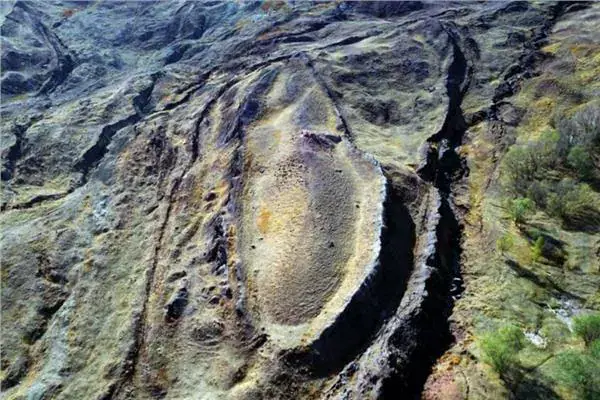
A research team working in the Dorubinar region of eastern Turkey, near Mount Ararat, has extracted charred and uncharred wood samples from a depth of approximately 9 meters underground. The team, led by Andrew Jones, founder of the Noah's Ark Ministries International, sent the samples to laboratories for analysis to determine their origin, age, and composition. The discovery has rekindled interest in the search for Noah's Ark, a site that has been a subject of fascination for decades.
The site, known as Dorubinar, has been a point of interest since 1948, when a local shepherd stumbled upon an unusual formation. The site gained further attention in 1959, when aerial images revealed a structure resembling a large boat or ship. Measuring approximately 515 feet in length, the formation has sparked debate among researchers and enthusiasts about its connection to the biblical story of Noah's Ark. The recent discovery of charred wood has added fuel to the debate.
The research team used ground-penetrating radar to survey the site, revealing linear patterns, intersections, and potential voids. These findings suggest the presence of internal compartments, corridors, and layers, which some interpret as evidence of a wooden structure. However, the team acknowledges that the results are not conclusive and require further analysis. The discovery of charred wood and potential voids has generated excitement among researchers, but also raised questions about the site's origins.
The team conducted drilling and sampling operations at the site in 2026, in collaboration with Turkish researchers and under the supervision of Professor Jenger Atilla from Sivas Cumhuriyet University. The samples were sent to universities and laboratories for further analysis. The researchers also collected soil samples and conducted geophysical surveys to gather more data about the site. The findings have sparked renewed interest in the search for Noah's Ark.
While the discovery of charred wood and potential voids is intriguing, it is not sufficient to prove that the site is the remains of Noah's Ark. Further analysis, including radiocarbon dating and examination of the wood's composition and properties, is necessary to determine the site's significance. The team plans to continue their research in 2027, conducting further surveys and analysis to shed more light on the site's mysteries.
The search for Noah's Ark has been ongoing for decades, with various theories and claims emerging over the years. The Dorubinar site has been the subject of several studies, with some researchers suggesting that it may be linked to the biblical story. However, others have raised questions about the site's geological formation and the possibility of natural explanations for the observed features.
As the research team continues their investigation, they hope to uncover more evidence about the site's origins and significance. While the discovery of charred wood is an exciting development, it is clear that the search for Noah's Ark is an ongoing and complex process. The team's findings will contribute to a deeper understanding of the site and its potential connection to the biblical story.
Key points
- The research team's discovery of charred wood at a depth of 9 meters in eastern Turkey has sparked renewed interest in the search for Noah's Ark.
- The site, known as Dorubinar, has been a point of interest since 1948, with some researchers suggesting that it may be linked to the biblical story of Noah's Ark.
- Further analysis, including radiocarbon dating and examination of the wood's composition and properties, is necessary to determine the site's significance.