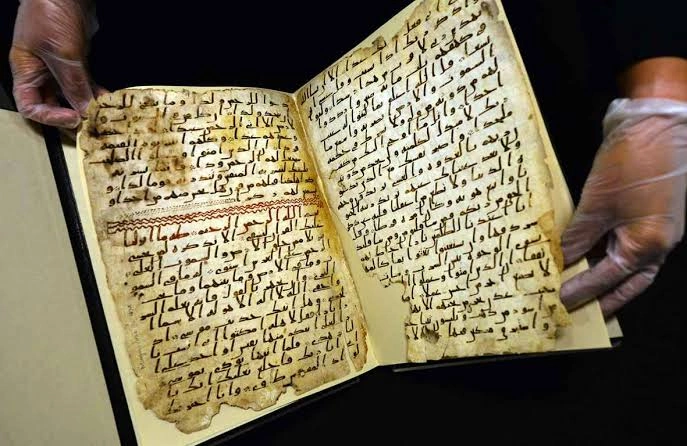
In a groundbreaking project, the University of Hamburg and the Berlin State Library are set to utilize artificial intelligence and computer vision to study 929 ancient Quran manuscripts from Yemen. Discovered in 1973 in the Great Mosque of Sanaa, these manuscripts date back to the 7th to 11th centuries and are among the oldest known handwritten testimonies of the Quran. The original manuscripts are currently inaccessible due to the political situation in Yemen.
The manuscripts were reproduced in the 1990s, resulting in approximately 24,000 microfilm images and 5,000 color slides and black-and-white photographs. In 2019, the Berlin State Library's Oriental Department acquired and digitized these reproductions. This digitization enables researchers to study the entire corpus as a whole for the first time. The project aims to reconstitute the history of this exceptional collection and shed light on the production, use, transmission, and material history of these ancient manuscripts.
For decades, the Sanaa manuscripts have been surrounded by speculation and controversy. The new research program seeks to provide a more comprehensive understanding of these texts. By employing AI and computer vision, researchers hope to analyze the manuscripts' content, script, and material properties. This study will contribute significantly to the field of Quranic studies and provide valuable insights into the history of Islamic texts.
The discovery of the Sanaa manuscripts in 1973 was a significant event in the field of Islamic studies. The Great Mosque of Sanaa, where the manuscripts were found, is one of the oldest mosques in the world. The manuscripts themselves are a testament to the rich cultural heritage of Yemen and the Islamic world. Despite their importance, the original manuscripts have been inaccessible to researchers due to the ongoing conflict in Yemen.
The collaboration between the University of Hamburg and the Berlin State Library is a significant step towards unlocking the secrets of the Sanaa manuscripts. By leveraging AI and computer vision, researchers can analyze large datasets and identify patterns that may not be visible to the human eye. This project has the potential to revolutionize the field of manuscript studies and provide new insights into the history of the Quran.
The study of ancient manuscripts is an interdisciplinary field that requires expertise in various areas, including Islamic studies, history, and computer science. The research team involved in this project comprises scholars from diverse backgrounds, ensuring a comprehensive approach to the study of the Sanaa manuscripts. The findings of this project will be published in academic journals and presented at conferences, contributing to the global discussion on Islamic studies.
The use of AI in manuscript studies is a rapidly growing field, with applications extending beyond Quranic studies. The methodologies developed in this project can be applied to the study of other ancient manuscripts, contributing to a deeper understanding of human cultural heritage. As the project progresses, it is expected to yield significant results that will shed new light on the history of Islamic texts and their significance in modern times.
Key points
- The project aims to study 929 ancient Quran manuscripts from Yemen using AI and computer vision.
- The manuscripts date back to the 7th to 11th centuries and are among the oldest known handwritten testimonies of the Quran.
- The study will provide new insights into the production, use, transmission, and material history of these ancient manuscripts.