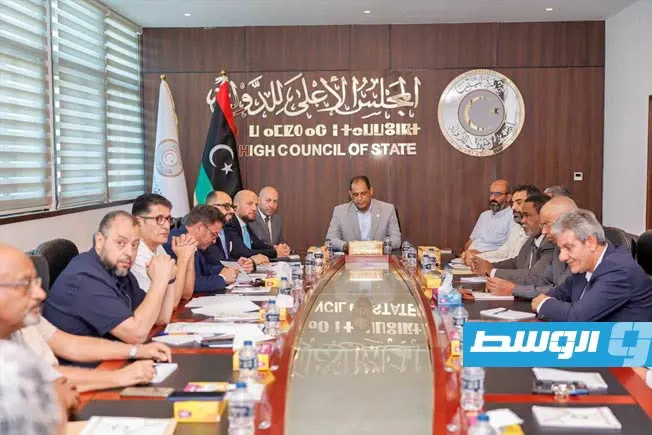
On September 29, 2026, representatives of Libya's transitional government, led by Prime Minister Abdul Hamid al-Dbeiba, met with members of the High Council of State, led by First Deputy Chairman Naji Muktar. The meeting was held to brief the Council on the details of the "4+4" track, a mini-dialogue process aimed at resolving the country's electoral impasse. The process is facilitated by the United Nations Support Mission in Libya.
The "4+4" track was agreed upon on August 30, 2026, in Tripoli, with the signing of a document outlining the framework for the electoral process. The document provides for the amendment of electoral laws and the appointment of a new board of directors for the National High Commission of Elections. The agreement was reached by representatives of the transitional government, the High Council of State, and the Libyan National Army, led by Field Marshal Khalifa Haftar.
The agreement proposes the reconstitution of the National High Commission of Elections, with the recommendation of Dr. Othman Abu Bakr as chairman and Ms. Sanaa al-Shtiwi as deputy chairman. The commission will comprise six new members, three from the House of Representatives and three from the High Council of State. The agreement also provides for the adoption of Law No. 28 of 2023 as the basis for the presidential election, with some amendments.
The amendments include allowing dual nationals to run for office, provided they renounce their non-Libyan nationality before taking the constitutional oath. The agreement also provides for a legal mechanism to re-hold the election if the condition cannot be met. The House of Representatives has endorsed the agreement, but it has been met with opposition from the Presidential Council, the High Council of State, and some political parties.
The opposition has expressed concerns that the agreement deviates from the constitutional framework and the transitional period's governing arrangements. On the other hand, the Libyan National Army and the transitional government have welcomed the agreement. The developments have sparked mixed reactions, with some stakeholders calling for a comprehensive political process.
In a related development, the House of Representatives has issued a package of laws and decisions, including the amendment of the law on the election of the president and the adoption of the law on the election of the House of Representatives. The Speaker of the House of Representatives, Aguila Saleh, has also approved the agreement reached by the "4+4" committee.
The agreement has significant implications for Libya's electoral process, which has been stalled for years. The country's international partners, including the United Nations, have expressed support for a peaceful and inclusive resolution to the crisis. The situation remains complex, with multiple stakeholders and competing interests at play.
Key points
- The "4+4" track aims to resolve Libya's electoral impasse through a mini-dialogue process.
- The agreement proposes the reconstitution of the National High Commission of Elections and the amendment of electoral laws.
- The developments have sparked mixed reactions, with some stakeholders calling for a comprehensive political process.