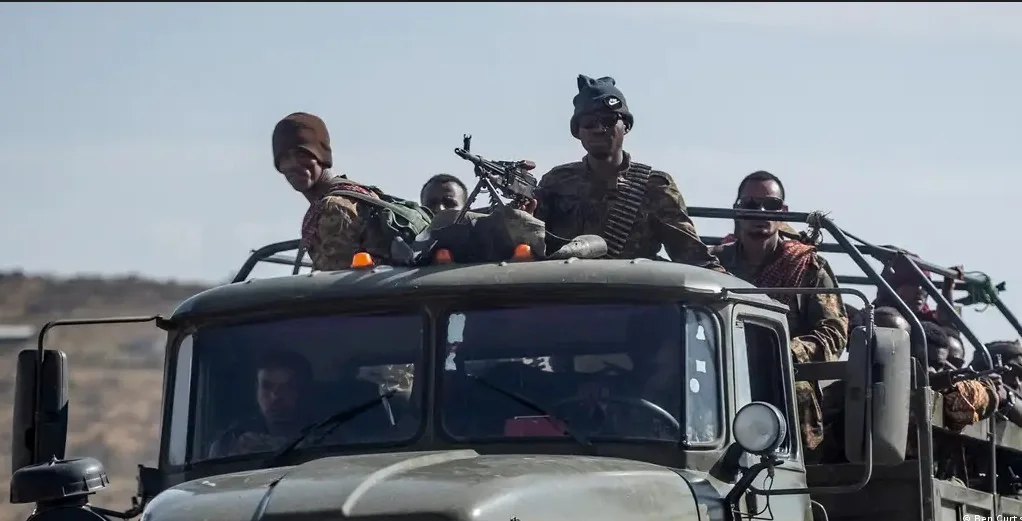
Four years after the 2022 Pretoria Peace Agreement ended the two-year Tigray war, fresh fighting has erupted in northern Ethiopia, raising concerns of prolonged instability across the Horn of Africa. The new armed conflict follows a recent announcement that several former adversaries have formed an alliance aimed at toppling Prime Minister Abiy Ahmed’s federal government. This development has sparked fears of escalating violence and humanitarian crises in the region.
The alliance, comprising several groups including the Oromo Liberation Army and a faction of the Ogaden National Liberation Front, has significant strategic coordination, though internal ethnic and political differences could undermine its durability. Eritrea, while not formally part of the alliance, is believed to be supplying support to the rebel groups, adding another layer of external involvement. Analysts warn that this external support could further complicate the situation.
Control Risks expects the fighting to stay largely confined to the border zones of Tigray, Amhara and Afar, noting that Ethiopia’s rugged terrain and fragmented opposition make a nationwide expansion unlikely. However, the renewed conflict has forced civilians to flee their homes, adding to an internally displaced population that has not returned since 2020. This has resulted in a growing humanitarian crisis.
The crisis has also disrupted essential services, with telephone and internet services cut in parts of Tigray and Amhara. Flights to cities such as Kombolcha and Lalibela have been suspended, further exacerbating the situation. The humanitarian impact of the renewed fighting is significant, with many civilians affected.
According to DW journalist Negash Mohammed, the Pretoria agreement excluded three pivotal actors: Eritrea’s military role, the Amhara militia known as Fano, and hard-liners within the TPLF who viewed the deal as a concession to defeat. These exclusions have contributed to the current instability. Subsequent attempts by Addis Ababa to disarm Fano without addressing their grievances further strained relations.
Analysts point to a decline in international focus after the agreement, allowing both sides to rearm and recruit while sanctions on Ethiopia were lifted by the United States, reducing Western leverage for renewed negotiations. The current situation highlights the challenges of sustaining peace agreements and the need for continued international engagement.
Outgoing UN Secretary-General António Guterres has sent a special envoy to the Horn of Africa to engage the African Union, regional powers and Egypt, but analysts warn that meaningful talks are unlikely until at least one party recognises that continued violence will not achieve its aims. Control Risks’ Patricia Rodrigues cautions against expecting a swift diplomatic solution, noting that while fighting may remain geographically contained, it is likely to persist.
Key points
- The renewed fighting in northern Ethiopia threatens to destabilize the fragile peace and endanger civilians.
- The alliance of former adversaries has significant strategic coordination but faces internal challenges.
- The crisis has resulted in a growing humanitarian crisis, with many civilians displaced and essential services disrupted.