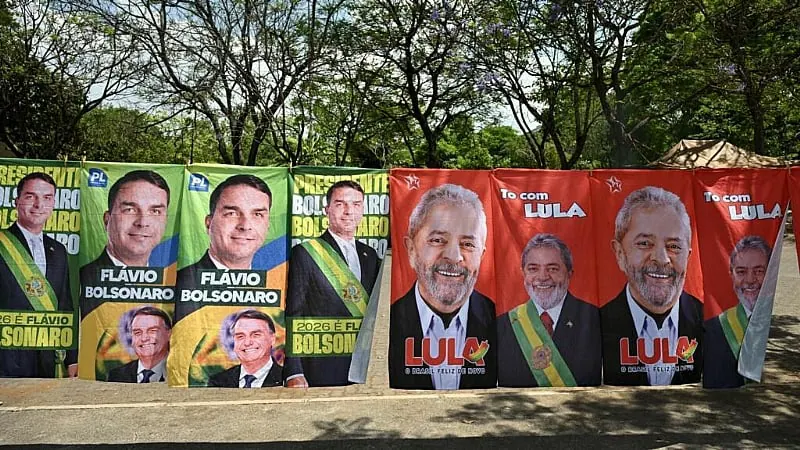
The campaign for the Brazilian presidency has become increasingly polarized, with President Luiz Inacio Lula da Silva and his rival Flavio Bolsonaro engaging in a series of controversies and insults. The two candidates are vying for the support of the nation's 160 million registered voters, with opinion polls predicting a tight race that may go to a run-off on October 25. Lula, 80, is seeking a fourth non-consecutive term, while Flavio Bolsonaro, 45, is the son of former far-right president Jair Bolsonaro.
The campaign has been marked by scandals and insults, with both sides attempting to discredit each other and win over undecided voters. Lula has unveiled a series of measures to win over voters, including increasing social welfare payments and banning sports betting. Flavio Bolsonaro has focused on his promise to be tough on crime, a key concern for many Brazilians. US President Donald Trump has expressed support for Flavio Bolsonaro, saying he is watching the election "very closely".
A recent controversy surrounding Brazil's patron saint, Our Lady of Aparecida, has highlighted the tensions between the two candidates. Rumors emerged that Flavio Bolsonaro planned to strip the saint of her post if elected, prompting Lula to take to the campaign trail clutching a statue of the saint. The electoral court has ordered that posts with the "untrue" claims be taken down. The incident has underscored the deep-seated divisions in Brazilian society.
The candidates have also engaged in personal attacks, with Lula accusing Flavio Bolsonaro of being unqualified to serve as a building manager. Flavio Bolsonaro has responded by accusing Lula of being sexist, after Lula made comments about men's attitudes towards gynecological exams. The exchanges have done little to ease the polarization of the electorate, with many voters expressing disenchantment with their options.
Despite the controversies, Lula remains a significant force in Brazilian politics, with a strong track record of curbing deforestation in the Amazon rainforest and overseeing economic growth. His supporters argue that he has the political clout and credibility to carry out reforms. Edinho Silva, president of Lula's Workers' Party, has expressed confidence in Lula's ability to win the election.
Flavio Bolsonaro has also faced challenges, including an investigation into corruption over the financing of a biopic about his father. He has admitted to asking a jailed banker to bankroll the film, but remains confident of a first-round win. His supporters argue that he is the best option for tackling crime and corruption in Brazil.
As the election approaches, voters are increasingly divided, with many expressing skepticism about both candidates. Gisele Sousa, a clothing shop employee, has said that she will not vote for either candidate, describing the campaign as a "circus". Marcelo Vilanova, a fish market manager, has expressed support for Lula, citing his social welfare programs, while Lucas Sales, a cell phone shop owner, is voting for Flavio Bolsonaro due to his promise to tackle crime.
Key points
- The Brazilian presidential election is expected to be a close contest between Lula and Flavio Bolsonaro.
- The campaign has been marked by controversies and personal attacks between the two candidates.
- The election outcome may have significant implications for Brazil's economic and environmental policies.