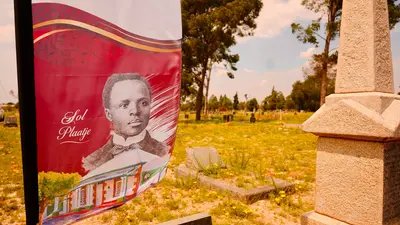
Solomon Tshekisho Plaatje was born on October 9, 1876, and is remembered as one of South Africa's great literary and political figures. His many achievements are justly celebrated, and his vision of what South Africa could be inspired not only his contemporaries but later generations too. Two of his passions, equal rights before the law and equal status for South Africa's indigenous languages, have found expression in South Africa's Constitution.
Plaatje's legacy extends beyond his literary works, with numerous honors and recognitions. In 2004, he was awarded the Order of Luthuli in Gold, the country's highest award, for his exceptional contribution to the struggle for democracy, human rights, and justice in South Africa. A university in Kimberley, his hometown, was named after him and opened its doors to students in 2014. Today, the Sol Plaatje University has over 7,000 students.
Plaatje's life was one of commitment to the cause of his people. He was one of the founders of the South African Native National Congress, the precursor to today's ANC, in 1912, and was its first secretary general. He led the campaign against the infamous Natives Land Act of 1913, travelled to England in 1914 as a member of a Congress deputation to protest against the British imperial government.
During his time in England, Plaatje wrote his famous book, Native Life in South Africa, setting out the case of his people against the increasingly oppressive policies of the South African government. He continued to present their case at meetings, in speeches, and in numerous newspaper articles for the remainder of his life. His written record documents and condemns South Africa's turn to segregation in the early years of the past century.
Plaatje made significant contributions to journalism and language preservation. In 1914, he made his name as a journalist, editor of his own newspapers, and contributor to white-owned newspapers. He also worked on preserving Setswana, his native tongue, by creating a book of proverbs and a phonetic guide. Additionally, he translated some of Shakespeare's plays into Setswana, showcasing the language's richness.
Plaatje's work was not done in isolation; he had a network of supporters who helped him throughout his life. His wife, Elizabeth, a former teacher, devoted much of her life to supporting her husband and raising their children. Other supporters included missionaries, Barolong chief Silas Molema, and white sympathizers in England, such as Georgiana Solomon.
As South Africa celebrates the 150th anniversary of Sol Plaatje's birth, it is essential to remember the network of people who made his achievements possible. His legacy serves as a testament to the power of collaboration and determination in the face of adversity.
Key points
- Sol Plaatje was a founding member of the South African Native National Congress and played a crucial role in the fight against the Natives Land Act of 1913.
- Plaatje's literary works, including Native Life in South Africa and Mhudi, provide valuable insights into the experiences of his people during a tumultuous period in South African history.
- The Sol Plaatje University in Kimberley, named in his honor, has grown to become a reputable institution with over 7,000 students.