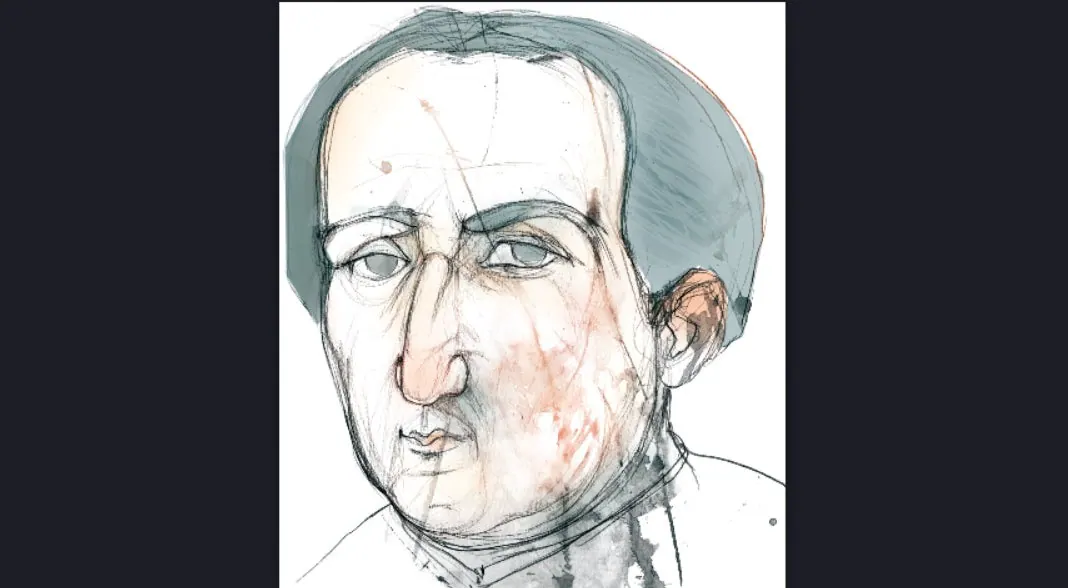
This October, as the world reflects on the legacy of Christopher Columbus, another figure from the Iberian age deserves remembrance: Abraham Zacuto, a Jewish astronomer born in Salamanca around 1452. Zacuto's work helped give oceanic navigation a new degree of precision and practicality, making sustained oceanic voyaging possible. His contribution belongs not at the margins of the Age of Exploration but within the scientific infrastructure that made long-distance navigation increasingly systematic.
Zacuto's great Hebrew astronomical work, Ha-Hibbur ha-Gadol (The Great Composition), was completed around 1478. Working within a long scientific conversation that included Greek, Islamic, Jewish, and Christian astronomy, he refined and organised astronomical calculations in forms of exceptional practical value. After the expulsion from Spain in 1492, Zacuto entered Portugal, where he continued his work, and his pupil, José Vizinho, helped present his astronomical material in practical Latin and Castilian.
In 1496, Zacuto's Almanach Perpetuum was printed at Leiria in four known issues, supplying precise, ready-to-use values for the changing position of the sun through the year. For pilots on the high seas, this meant that a noon observation of the sun could be combined with solar-declination data to determine latitude – the ship's north-south position. The difficult astronomical calculations had already been embodied in the tables, making daytime position-finding at sea much easier.
The importance of Zacuto's tables was evident in their widespread adoption. The Almanach was reprinted repeatedly in Venice in 1498, 1502, 1525, and 1528, and its tables entered early Portuguese navigational manuals, becoming part of the practical scientific culture of oceanic travel. Zacuto's astronomical material was also translated and adapted into Arabic, with versions produced in Istanbul and Morocco.
Zacuto's name became entwined with the memory of great navigators, including Columbus and Vasco da Gama. Accounts connect his tables with Columbus's famous 1504 lunar eclipse in Jamaica, where Columbus predicted the disappearance of the moon using Zacuto's almanac. A manuscript connected with the Almanach survives in Seville's Biblioteca Colombina, the library created by Columbus's son Hernando.
Despite his influence, Zacuto's own life was marked by persecution and exile. In 1497, the Portuguese crown subjected the Jewish population to mass forced conversion, and Zacuto left Portugal. He moved through North Africa, including Tunis, before eventually reaching Jerusalem, where he continued his astronomical work, recalculating and updating his earlier tables for the Jewish calendar and the meridian of Jerusalem.
Zacuto's legacy endures in modern celestial navigation, which still determines position by combining observations of the sun, moon, planets, or stars with authoritative astronomical data. The US Naval Academy requires all midshipmen to study navigation, including celestial navigation, and the US Naval Observatory describes it as a critical independent backup to GPS and other electronic systems. Zacuto's story joins two strands of Sephardic history: persecution and exile, and the transmission of knowledge, texts, and technologies across borders.
Key points
- Zacuto's work helped make oceanic navigation more precise and practical.
- His tables were widely adopted and influenced explorers like Columbus and Vasco da Gama.
- Zacuto's legacy endures in modern celestial navigation.