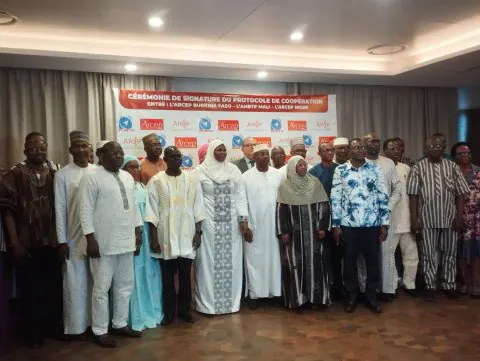
The authorities responsible for regulating electronic communications in Burkina Faso, Mali, and Niger signed a cooperation agreement on September 25, 2026, in Ouagadougou, giving rise to the Sahel Regulators Council (CRS). This permanent framework aims to enhance consultation and coordination among the three countries of the Alliance of Sahel States (AES). The agreement was signed by the ARCEP Burkina Faso, AMRTP Mali, and ARCEP Niger.
The CRS aims to harmonize regulatory practices in the three countries. The agreement outlines five main priorities: harmonizing legislative and regulatory frameworks, protecting consumers and users, coordinated development of electronic communication infrastructures, coherent tariff policies, and defining common positions in international organizations. The agreement also covers operational aspects, including frequency coordination and control at borders.
The cooperation will focus on introducing 5G and emerging technologies such as artificial intelligence, virtual and augmented reality, and the Internet of Things. The regulators also plan to share tools for controlling the spectrum, service quality, and fiber optic networks. To implement these commitments, the regulators will hold trilateral consultations, exchange information and best practices, and organize training sessions and expert exchanges.
Dr. Aminata Zerbo/Sabané, Minister of Digital Transition, Posts, and Electronic Communications of Burkina Faso, emphasized that the CRS reflects the willingness of the three states to work together and find common solutions to problems that transcend AES state borders. She highlighted that the CRS should be a working framework for regulators to exchange, share expertise, and develop common reflections.
Dr. Pasteur Poda, President of the ARCEP Burkina Faso regulatory council, stated that the CRS aims to conduct common actions for more effective and productive regulation for the benefit of AES populations. He outlined that the agreement provides for trilateral consultations, working groups, information exchanges, and expert training. The CRS governance will involve each country in the continuity of the framework.
The presidents of AMRTP Mali and ARCEP Niger, Saïdou Pona Sankaré and Moussa Zeinabou Seyni, respectively, emphasized that the CRS aims to strengthen the capacity of the three countries on the international scene. They highlighted that the cooperation will enable the countries to take solidary and concerted positions in international forums, such as the International Telecommunication Union.
The implementation of the free roaming, one of the most anticipated outcomes of the CRS, aims to allow citizens of AES countries to communicate more easily when traveling between Burkina Faso, Mali, and Niger under more advantageous and transparent conditions. The regulators will now elaborate and adopt the statutes and internal regulations of the CRS to translate the commitments into concrete actions for the benefit of users and the electronic communications and postal sectors.
Key points
- The Sahel Regulators Council (CRS) was created to strengthen consultation and coordination between the regulators of Burkina Faso, Mali, and Niger.
- The CRS aims to harmonize regulatory practices in the three countries and focus on introducing 5G and emerging technologies.
- The implementation of the free roaming is one of the most anticipated outcomes of the CRS.