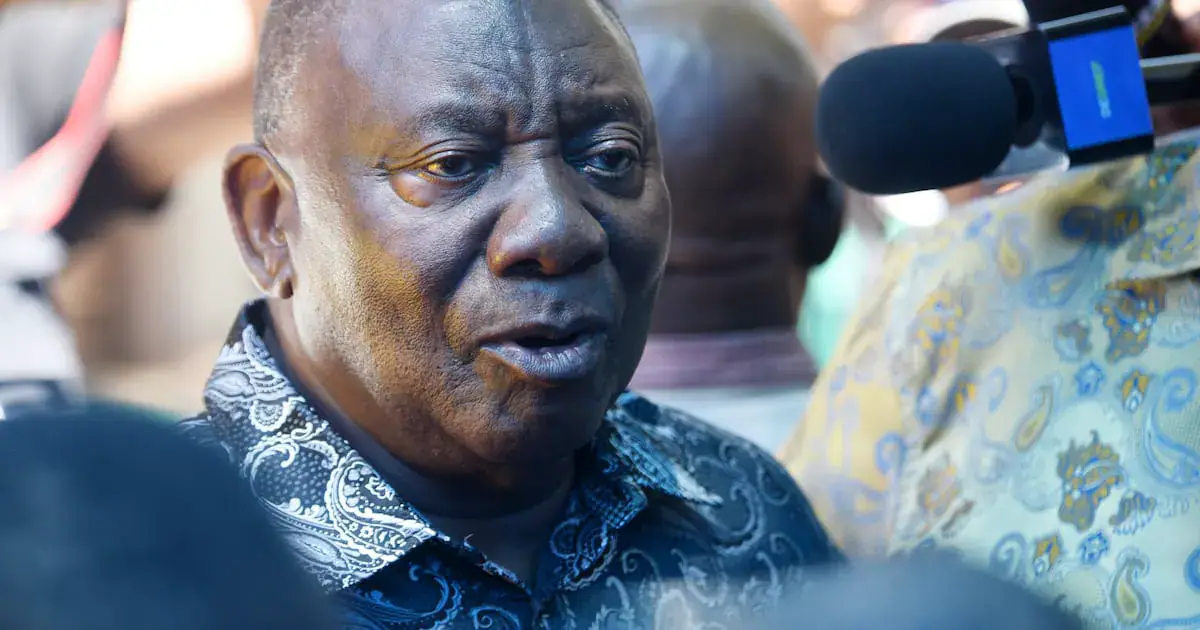
President Cyril Ramaphosa and other senior leaders of the African National Congress (ANC) have discussed the possibility of resigning from top party posts following the party's devastating showing in the local government elections. According to several ANC national executive committee (NEC) members, Ramaphosa raised the prospect of resigning as party leader after the ANC's poor election performance. This discussion was reportedly prompted by the ANC's head of elections, Mdumiseni Ntuli, who suggested that the NEC should reflect on the ANC's electoral outcomes.
The ANC's poor performance in the local government elections has sparked a heated debate within the party about who should take responsibility for its electoral collapse. At least five senior NEC members have told the Sunday Times that Ramaphosa suggested he should step down, arguing that the party could not suffer two successive election defeats under his leadership without consequences. The ANC's national footprint in the local polls has dropped significantly, from 49.9% in 2021 to 36.9% in 2026.
Ramaphosa's proposal was reportedly met with resistance from second deputy secretary-general Maropene Ramokgopa, who urged him to calm down and instead consider an early national conference in April. Ramokgopa suggested that the party should go to an early conference and not resign, and that the conference could be held as early as April. She also suggested that the party skip the branch process and ask branch leaders to send two delegates each.
The discussion about Ramaphosa's resignation was said to have been serious, with the president even suggesting that if the ANC's top seven national officials were not willing to vacate their posts, he could resign on his own. However, Ramaphosa's call is said to have been rejected by several ANC leaders, including the party's deputy president, Paul Mashatile and Ramokgopa. Mashatile argued that resigning was not an option and that the party should take time to reflect.
The ANC's poor performance in the local government elections has significant implications for the government of national unity (GNU). If Ramaphosa were to resign as ANC president, it would likely spell the end of the GNU. The ANC has lost its majority in all the Gauteng metropolitan municipalities and Nelson Mandela Bay in the Eastern Cape to the DA, and in eThekwini in KwaZulu-Natal to the MK Party.
This is not the first time Ramaphosa has threatened to resign as ANC president. In 2022, he summoned his allies to Tuynhuys, his official residence in Cape Town, where he announced that he intended to step down following a parliamentary panel's finding that he had a case to answer over the Phala Phala scandal. However, he was subsequently persuaded to reconsider.
The ANC's poor performance in the local government elections has sparked a renewed debate about the party's leadership and its ability to govern effectively. The party's treasurer-general, Gwen Ramokgopa, reportedly argued that if the national officials were to be held accountable for the election outcome, they should not resist if the NEC called for them to step down. The ANC's NEC will likely continue to discuss the party's future and the implications of Ramaphosa's potential resignation.
Key points
- Ramaphosa considers resigning as ANC leader after poor election performance.
- ANC leaders reject Ramaphosa's proposal, suggesting an early national conference instead.
- Ramaphosa's resignation would likely spell the end of the government of national unity.
Reporting sources
- # 1 Ramaphosa considers quitting as ANC reels · The Sunday Times