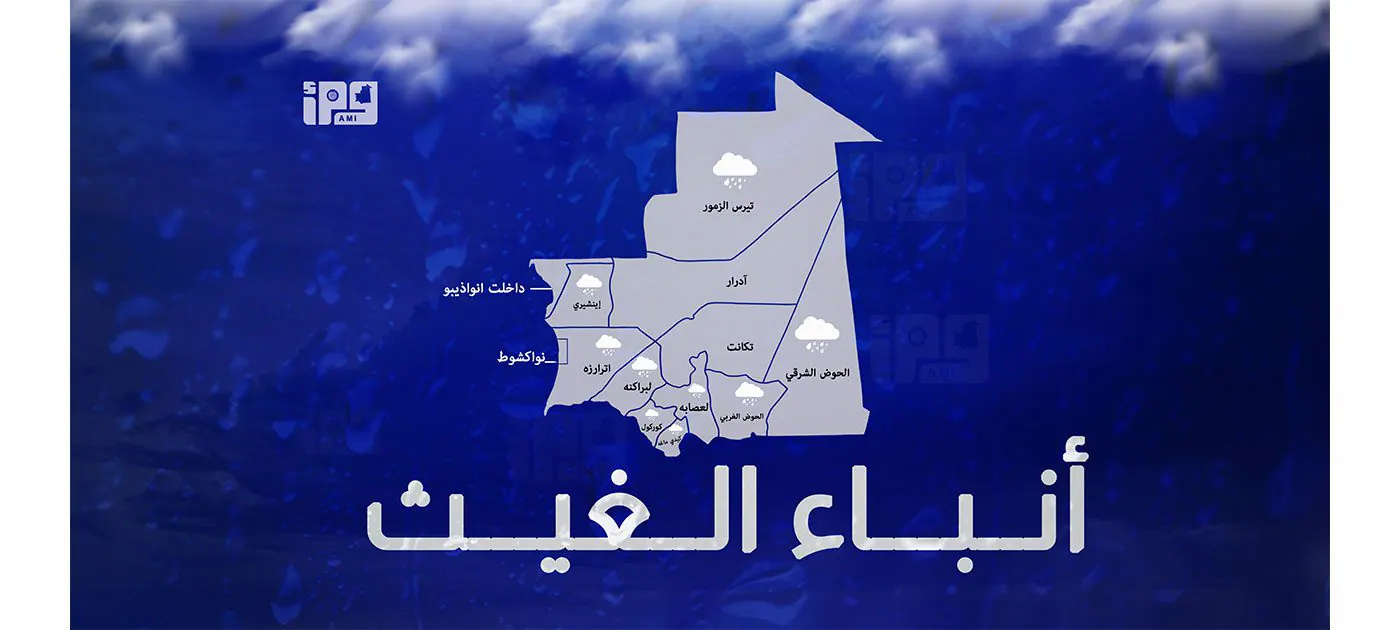
Over the past 48 hours, Mauritania has seen significant rainfall in multiple regions, according to data from the Administrative Communications Service of the Ministry of Interior, Decentralization, and Local Development. The regions affected include the Eastern and Western Hodh, Assaba, Korkol, L'Erg Chebbi, Brakna, Trarza, and Adrar. The rainfall varied greatly from one area to another.
In the Eastern Hodh region, the town of Ambiriké in the Nema district recorded 40 mm of rain, while in the Adil Bekro district, the towns of Bâghla and Adil Bekro received 10 mm and 2 mm, respectively. Meanwhile, in the Western Hodh, the Tinetan district's Aouinat El Tal area got 125 mm, and the Kobeni district's Tridat, Madbuku, and Tarhayah areas received 85 mm, 45 mm, and 30 mm, respectively.
The Assaba region also experienced substantial rainfall, particularly in the Kankousa district, where Amjinger received 80 mm. In the Barkol district, Laouisey and Barkol recorded 10 mm and 4 mm, respectively. Korkol region saw significant rainfall, with the Kihédi district's Arone, Dendé, and Tifondissèfeh areas getting 35 mm, 22 mm, and 17 mm, respectively.
Further rainfall was reported in the L'Erg Chebbi region, particularly in the Moudjeria district, where Azrik T Ahl Habibi, Fam El Khlitta, and Rakanou 1 areas received 121 mm, 115 mm, and 107 mm, respectively. Other areas, such as Kôb Ahl Jaafar and Al Khawa Iflan, got 105 mm and 100 mm. The Brakna region also experienced rainfall, with the Aleg district's Shakar, Al Wad Gharq, and Aghchourkit areas recording 18 mm, 15 mm, and 3 mm.
In the Trarza region, the Rosso district's Krom Madik area received 100 mm of rain, while Baghdad and Achkarta got 80 mm each. The Rosso area itself recorded 55 mm. Additionally, the Tidjikja district in the Tagant region reported various amounts of rainfall across different areas. The Adrar region also saw some rainfall, with the Chinguetti district's Chinguetti town getting 24 mm.
Other regions that experienced rainfall include Kédiema, where the M'Bou district's Windesine area received 40 mm, and the Gabou district's Goukntorou area, which got 45 mm. The Siilibabi district in the Kédiema region reported 60 mm in the Wol M'Béni Souninké area. These scattered rainfalls brought much-needed moisture to various parts of the country.
The varying amounts of rainfall across different regions are crucial for agriculture and water resources in Mauritania. While some areas received substantial amounts, others got relatively little. The distribution of rainfall across the country will likely have a significant impact on the environment and local communities.
Key points
- Rainfall amounts vary greatly across regions, ranging from 02 mm to 125 mm.
- Eight regions of Mauritania are affected by the rainfall, including Hodh, Assaba, and Adrar.
- The rainfall is expected to have a significant impact on agriculture and water resources in Mauritania.