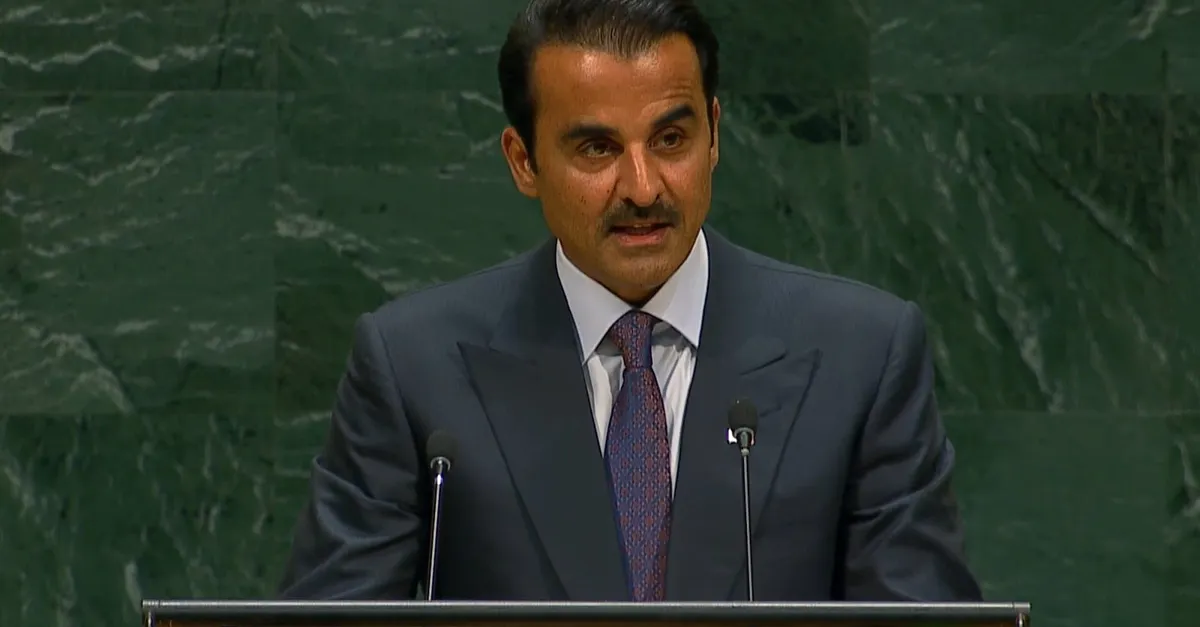
Qatar's Emir, Sheikh Tamim bin Hamad Al Thani, has warned that the Middle East is going through one of its most critical and dangerous phases due to years of temporary solutions and unrealistic policies. Speaking at the UN General Assembly, he emphasized that the current tensions stem from the absence of a collective security system that requires all parties to resolve conflicts peacefully. This, he said, has enabled some countries to drag their neighbors into wars that are not theirs.
The Emir of Qatar highlighted the importance of a collective security system, stressing that its absence has allowed some countries to threaten the livelihoods of others, citing the Strait of Hormuz as an example. He also emphasized Qatar's commitment to mediation and diplomacy to prevent further escalation in the region. According to Sheikh Tamim, wisdom and resilience go hand-in-hand, and Qatar prioritizes dialogue and negotiation to resolve disputes in the Gulf.
Sheikh Tamim described the situation in Gaza as "genocide" and a "stain on humanity," reiterating Qatar's rejection of calls for the displacement of Gaza's population. He warned against attempts to undermine the basics of life and reconstruction in the sector. The Emir also stated that Qatar has been working tirelessly to establish a ceasefire and transition to a lasting peace, calling on Israel to fulfill its commitments to stop military operations, lift the blockade, and withdraw completely from the sector.
The Emir of Qatar also pointed out that Israel's aggressive behavior has extended to neighboring countries, threatening regional security. He criticized Israel's insistence on not adhering to agreements and dealing with a "logic of guardianship." In this context, Sheikh Tamim stressed the importance of Lebanese state sovereignty over its entire territory, emphasizing that the legitimate monopoly on weapons is essential for the state's survival.
Sheikh Tamim expressed Qatar's support for the political process and national reconciliation efforts to unify institutions in Libya. He also backed UN efforts to reach a comprehensive and sustainable political settlement in Yemen. The Emir's statements reflect Qatar's commitment to regional stability and its efforts to promote peaceful conflict resolution.
The situation in the Middle East remains volatile, with multiple conflicts and tensions threatening regional security. The Emir of Qatar's speech at the UN General Assembly highlights the need for a collective approach to address these challenges. Qatar's commitment to mediation and diplomacy is seen as a crucial step towards reducing tensions and promoting peace in the region.
The international community is closely watching developments in the Middle East, with many countries calling for an end to violence and a return to peace talks. The Emir of Qatar's warnings and proposals reflect the growing concerns about the region's stability and the need for a collective response to address the complex challenges facing the Middle East.
Key points
- Qatar's Emir Sheikh Tamim bin Hamad Al Thani calls for a collective security system to resolve conflicts peacefully in the Middle East.