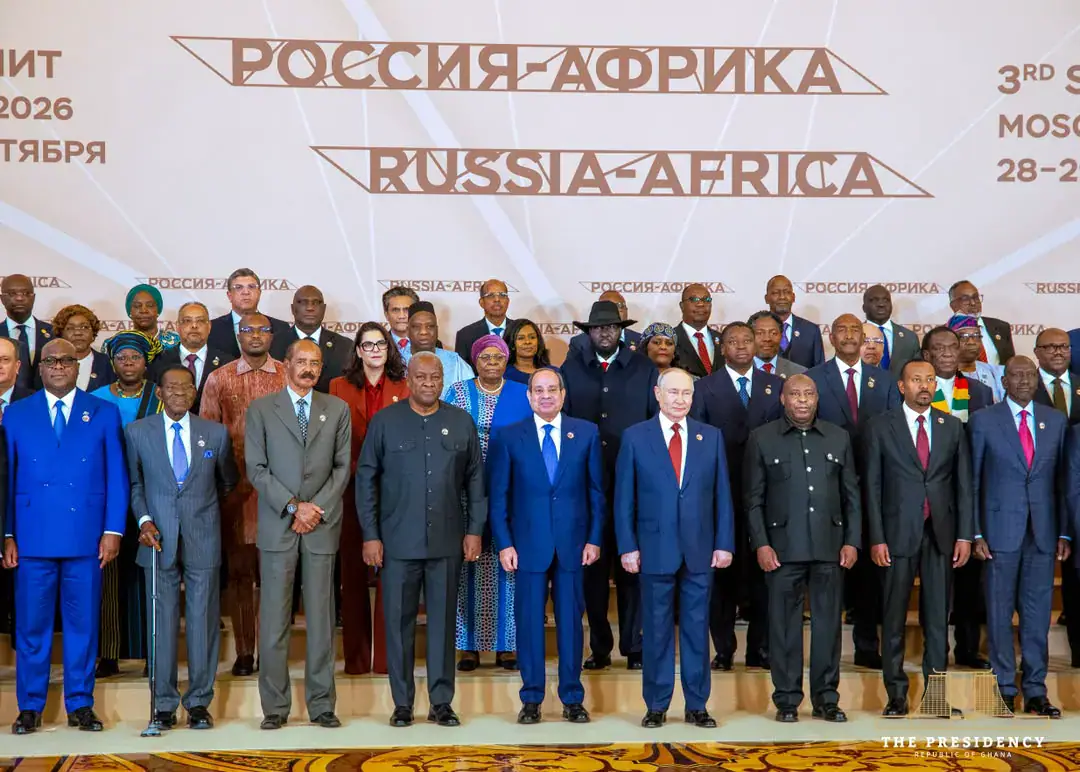
Russian President Vladimir Putin has hosted dozens of African leaders in Moscow for a high-stakes summit aimed at expanding Russian influence across the continent. The gathering, which drew representatives from nearly 50 African nations, including about 20 heads of state or government, marks part of a broader push to deepen relations with a continent of nearly 1.6 billion people. African nations represent a formidable political force, forming the largest voting bloc at the United Nations with 54 member states.
Putin framed the relation as an enduring strategic alliance, saying "Russia and Africa are united by truly strong bonds of friendship and close partnership." He leaned heavily on historical ties dating back to Soviet support for African independence movements, positioning Moscow as a counterweight to Western influence in the developing world. Putin accused the West of still trying to exploit the continent's resources and using debt to hold back development.
The Russian leader emphasized Moscow's commitment to supporting African self-determination against external pressure, singling out active attempts by Western countries to drive Africans back into debt bondage through predatory financial terms. Putin said, "Russia has always been and remains committed to seeing African nations defend their sovereignty, achieve steady growth, and strengthen their economies and social sectors." He added that Moscow stands ready to continue working together with African nations to achieve these goals.
African leaders used the forum to demand structural changes to global institutions. Egyptian President Abdel Fattah el-Sisi emphasized the prerequisite of regional stability for economic progress, noting that "Africa's security and stability remain an essential condition for achieving the aspirations of its peoples." This sentiment was echoed by other regional leaders, who stressed the need for a more equitable global order.
Kenyan President William Ruto pressed for immediate reform of international governing bodies, arguing that "the international order must reflect the world as it is today, not the world as it was in 1945." Ruto's comments reflect a growing sentiment among African nations that the current global governance structure is outdated and in need of reform. The summit provided a platform for African leaders to voice their concerns and demands.
The Moscow summit serves as part of Russia's strategy to counterbalance pressure on the world stage from the West over Russia's war in Ukraine. By wooing African leaders and others from the Global South, Moscow aims to build a stronger coalition of support and challenge Western influence. Putin's rhetoric has resonated with many African nations, which have long been critical of Western powers and their perceived paternalistic approach.
The summit's outcomes and future implications remain to be seen, but one thing is clear: African nations are increasingly asserting themselves as key players in global politics and economics. As Putin noted, "Africa is increasingly asserting itself as one of the key players in the global economy and politics." With 54 member states at the United Nations, African nations have a significant voice in global affairs, and their relationships with other nations will continue to shape the course of international relations.
Key points
- Russia is positioning itself as a better partner for African nations than the "colonial" West.
- African leaders are demanding structural changes to global institutions and an end to Western influence.
- The Moscow summit marks a significant moment in Russia's efforts to expand its influence across Africa.