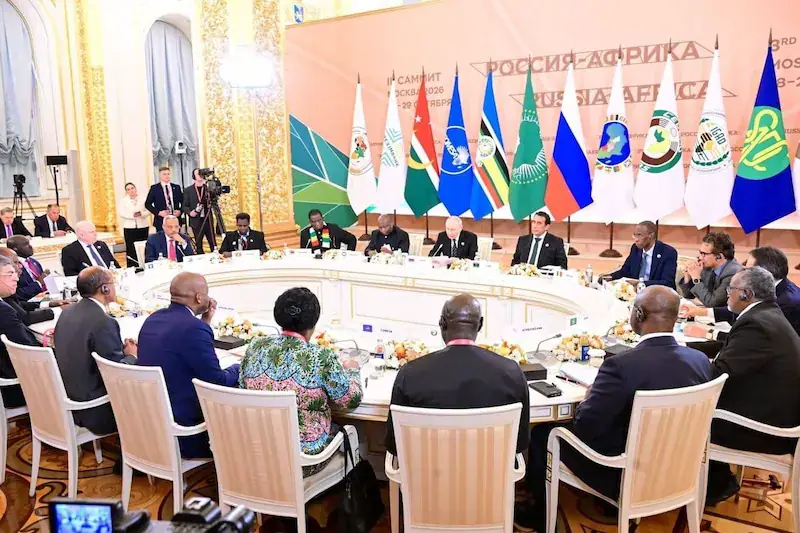
Russian President Vladimir Putin has outlined a comprehensive package of economic and strategic offers to African countries at the third Russia-Africa Summit in Moscow. The summit, co-chaired by Putin and Burundian President Évariste Ndayishimiye, brought together delegations from 48 African countries. Putin said 21 African heads of state attended, alongside senior government officials and representatives of continental and regional organisations. The summit sought to redefine relations between Russia and Africa at a time when African governments are increasingly looking beyond traditional Western partners for trade, investment, technology, and development financing.
Putin pledged to expand trade, increase investment, strengthen food security, support industrialisation, and deepen cooperation in education, healthcare, energy, and technology. He said Russian investments in Africa already amounted to tens of billions of dollars and expressed confidence that commercial exchanges could expand significantly through improved financial arrangements, removal of trade barriers, and stronger business partnerships. Russia offered to increase exports of industrial machinery, equipment, fertilisers, and agricultural products while expanding its purchases of African commodities and manufactured goods.
Food security featured prominently in Putin's proposals, with Russia pledging to remain a reliable supplier of grain to African countries. Moscow would continue supporting food security through grain deliveries, including free supplies where necessary, and share agricultural expertise and modern technologies to help African countries improve crop production, livestock farming, food processing, and storage. The proposals come as several African countries grapple with food insecurity, high agricultural production costs, climate change, and dependence on imported food.
Energy was another major pillar of the proposed partnership, with Russia offering cooperation in oil, gas, electricity generation, and nuclear technology. Putin noted the work of Russian state nuclear corporation Rosatom, which is constructing the El Dabaa nuclear power plant in Egypt. He said Russia was prepared to extend cooperation to other African countries interested in nuclear energy, including through small modular reactors and advanced nuclear technologies. The cooperation would also cover peaceful applications of nuclear science in medicine and agriculture.
Putin also offered African countries access to Russian digital technologies, including artificial intelligence, electronic trading platforms, and digital public administration systems. Russian companies were ready to introduce technological solutions across different sectors of African economies. Ndayishimiye said the summit had adopted a declaration on artificial intelligence, underscoring the importance of cooperation in technological development. For African countries, the opportunity lies in using such partnerships to develop local technological capacity, train digital professionals, and strengthen innovation.
Education was another area in which Putin announced specific commitments. He said more than 40,000 African students were studying at Russian universities during the 2026-2027 academic year. Russia had also allocated approximately 5,500 government-funded scholarship places for African students. Putin pledged to increase scholarship opportunities and expand cooperation between Russian and African universities, including through the establishment of university branches and educational centres. Russia also expressed readiness to promote Russian language and cultural institutions across the continent.
Beyond economic cooperation, the summit addressed international security, regional conflicts, and Africa's representation in global decision-making institutions. Putin described African countries as important partners in building a multipolar international order based on the United Nations Charter, sovereign equality, and mutual respect. He supported stronger African representation in international institutions, particularly the United Nations Security Council and international financial institutions. The summit's outcomes are expected to shape the future of Russia-Africa relations and have implications for the continent's development trajectory.
Key points
- Putin pledges to expand trade and investment with African countries, with a focus on industrialisation and job creation.
- Russia offers cooperation in nuclear energy, including through small modular reactors and advanced nuclear technologies.
- Putin announces increased scholarship opportunities for African students, with 5,500 government-funded places allocated.