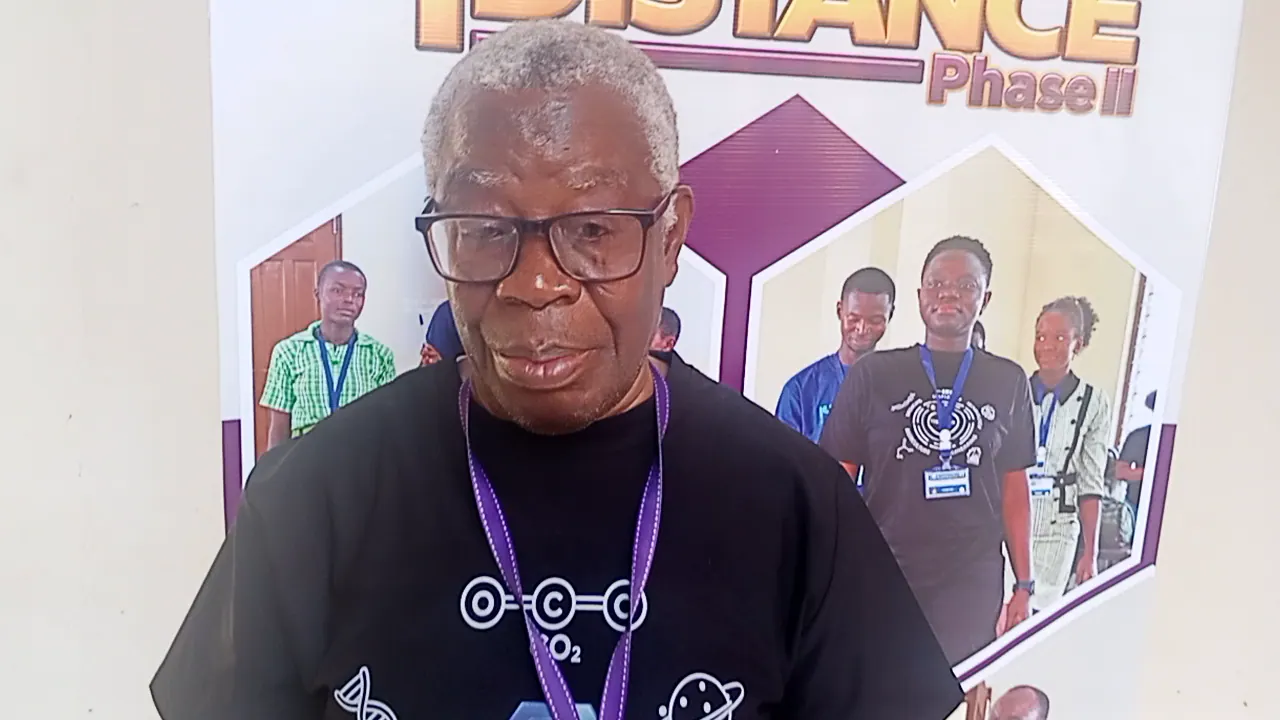
Professor Johannes Akpabla Mawuli Awudza of the Kwame Nkrumah University of Science and Technology (KNUST) has expressed concerns about the disparities in access to practical science education in Ghana. He notes that students in poorly resourced public schools are at a disadvantage when competing with their counterparts in better-equipped private schools. This disparity is particularly pronounced in deprived communities where public schools lack basic laboratory facilities and materials needed for practical science lessons.
Prof. Awudza raised these concerns during a practical science training programme for teachers at Gambibgo Community Day School in the Upper East Region. He highlighted that while some private and international schools have the resources to provide students with regular practical lessons, many public schools struggle to obtain even basic materials for scientific experiments. This has significant implications for students' ability to develop practical skills and understanding required for science education.
The KNUST lecturer questioned how students in deprived schools could be expected to compete fairly when they lack opportunities to develop the practical skills and understanding required for science education. He described the disparity as unfair, particularly because students from both public and private schools are assessed through the same examination system. Prof. Awudza emphasized that this disparity is particularly concerning in underserved communities in Northern and Western Ghana.
Prof. Awudza urged the Ghana Education Service and other education stakeholders to prioritize the provision of basic laboratory equipment and teaching materials to improve practical science education in public schools. However, he also noted that effective practical science teaching did not always require expensive laboratory equipment. Teachers could use affordable and locally available materials to demonstrate scientific concepts and conduct experiments.
The professor encouraged science teachers to adopt innovative teaching methods while calling on education authorities to ensure that schools have the basic resources required for effective teaching and learning. He also called for increased investment in educational infrastructure, learning materials, and teacher welfare, describing education as essential to Ghana's development. Prof. Awudza acknowledged government investments in school infrastructure but emphasized that providing buildings alone was insufficient to guarantee quality education.
Prof. Awudza expressed concern about disruptions to teaching and learning resulting from teacher absence. He urged the government and teacher unions to engage in constructive dialogue to resolve outstanding concerns affecting teachers and minimize disruptions to academic activities. The professor also called for stronger collaboration between government and local communities in the management of educational facilities.
Prof. Awudza maintained that improving educational outcomes would require sustained attention to infrastructure, practical learning resources, teacher welfare, and community participation. He emphasized that communities should take greater responsibility for protecting and maintaining school infrastructure provided in their areas to ensure that such investments continue to benefit learners.
Key points
- Students in public schools in Ghana are disadvantaged due to a lack of practical science facilities.
- The disparity in access to practical science education is particularly concerning in underserved communities.
- Improving educational outcomes requires sustained attention to infrastructure, practical learning resources, teacher welfare, and community participation.