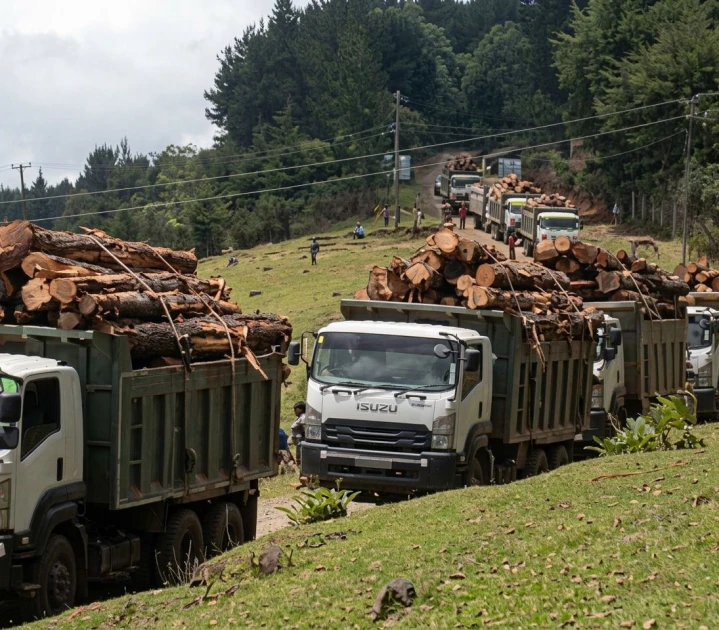
The spread of viral video footage showing heavy machinery and lorries transporting felled trees in Kenya's critical natural ecosystems has ignited fierce national outrage. The videos, which depict a massive endeavour at widespread logging, have struck a sensitive nerve across Kenya. Ordinary citizens, environmental activists, and civil society groups have taken to social media and public platforms to condemn what they describe as a blatant ecological betrayal by President William Ruto's administration.
The videos, which have been identified as being filmed in Keraita Forest, Karura Forest, and the Aberdare Ranges, show a procession of large white trucks loaded with logs, attempting to climb steep, dusty dirt hills and slowly crawling along narrow paved roads. Fact-checkers have confirmed the locations as premier conservation and eco-adventure areas in Kiambu County and the Aberdares. The footage highlights the large-scale logging transport operations in these rural Kenyan highlands, capturing both the challenging logistics and the public helplessness of timber extraction.
Kenyans online have voiced profound disappointment, accusing the government of sacrificing long-term ecological stability for short-term commercial forestry revenue and infrastructure expansion. The ongoing logging and land clearing stands in sharp contrast to President Ruto's highly publicised environmental commitments, including the 15 Billion Tree Pledge. Under this pledge, President Ruto committed to planting 15 billion trees over a ten-year period, aiming to raise Kenya's tree cover from under 10 per cent to 30 per cent by 2032.
The administration's decision to lift the commercial logging ban in 2023 has been criticised for paving the way for aggressive tree cutting and environmental degradation. Environmentalists have pointed to recent legislative amendments and executive support for projects such as roads through the Aberdares and urban developments that permit clearing inside protected public forests. Domestic conservationists have contended that local policy enforcement has prioritised commercial timber interests and aggressive development at the expense of indigenous biodiversity and protected catchment areas.
Citizens have labelled the government's approach contradictory, asking citizens to plant saplings on weekends while permitting the felling of mature, ecosystem-critical trees during the week. Many have expressed heartbreak and disappointment, with one Kenyan describing the videos as "a complete heartbreak" and another accusing President Ruto of "ecological betrayal". Environmental activists have continued to warn that continuous canopy destruction and proposed road cut-throughs threaten wildlife corridors, accelerate soil erosion, and compromise water catchments.
Historically, forests like Karura and the Aberdares have long been battlegrounds against illegal land grabbing, state-sanctioned logging, and deforestation. The resistance led by Wangari Maathai and the Green Belt Movement in the 1990s established a legacy where forest destruction is viewed not just as environmental damage, but as an attack on public heritage. Critics have noted that Kenya still relies on five primary catchments, including the Aberdare Range and Mount Kenya, to feed its rivers, fuel hydroelectric generation, and supply agriculture.
Environmentalists and citizens are calling for immediate policy accountability, transparency on logging permits, and an end to commercial exploitation inside protected public forests. The government's approach has been described as suffocating, with many demanding action to protect Kenya's natural ecosystems. As a symbol of Kenya's environmental liberation fought for by Professor Wangari Maathai, Karura Forest has kicked off widespread concern about tree clearing, infrastructure encroachment, and controversial management shifts by state agencies.
Key points
- The Kenyan government faces accusations of ecological betrayal over large-scale logging in critical ecosystems.
- The videos showing logging in Keraita Forest, Karura Forest, and the Aberdare Ranges have sparked national outrage.
- Environmentalists warn that the destruction of water towers threatens wildlife corridors, soil erosion, and water catchments.