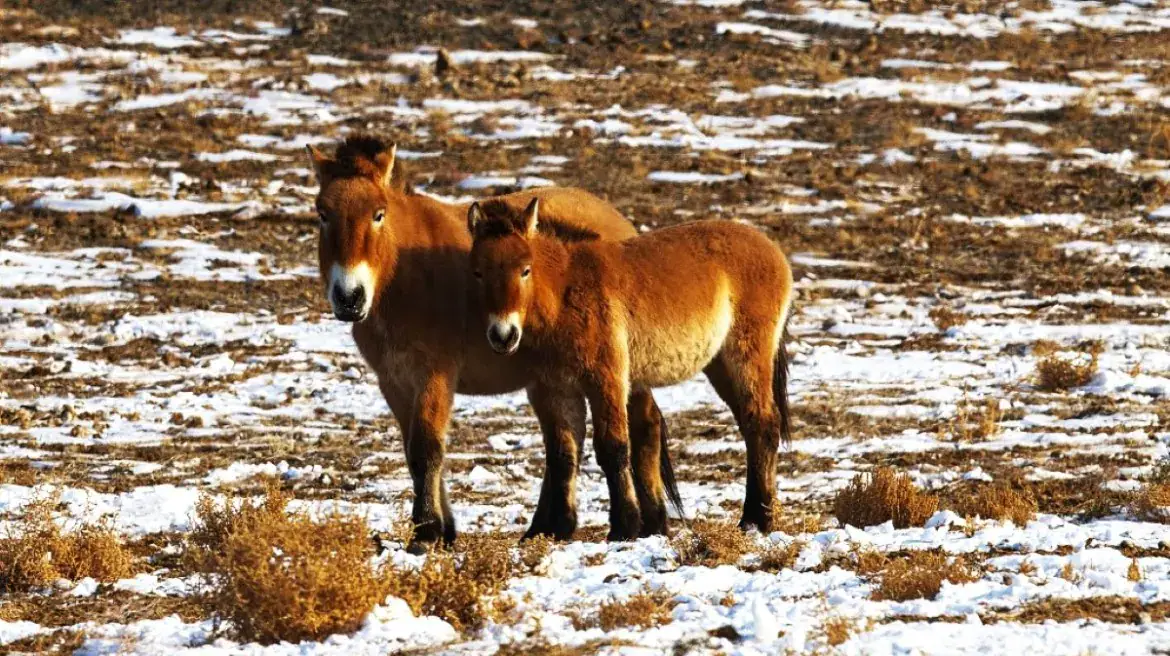
In northwest China's Xinjiang Uygur Autonomous Region, the Kalamaili Nature Reserve is now home to small herds of Przewalski's horses, the world's last surviving wild horse species. The horses roam freely, searching for food and water, navigating harsh weather, and galloping across the open land. This scene was unimaginable just two decades ago, as the horses had disappeared from the wild in China by the 1970s.
China's conservation efforts began in 1985, when 11 Przewalski's horses were brought from Germany and the United Kingdom to Xinjiang. The Xinjiang Wild Horse Breeding and Research Center was established to help the species recover. By 2000, around 100 foals had been born at the center. The ultimate goal was to return the horses to the wild, where they would have to survive on their own.
The first reintroduction attempt in 2001 was unsuccessful, as 27 horses were released directly into the reserve without preparation, resulting in three deaths. However, a more gradual approach was later adopted, with horses spending six months to a year in a transitional area within the reserve, learning to find food and water and adjust to life with less human assistance.
The transitional area, covering roughly 20 square kilometers, allows the horses to become familiar with the landscape and develop their survival skills. Food is provided only once every three to five days, encouraging them to forage independently. According to Xue Jiannan, an animal science engineer, the horses have keen senses, detecting where grass and water are more abundant outside.
Despite preparation, survival is not guaranteed, and rangers monitor the herds, intervening when necessary to provide food or water during extreme weather. In 2016, a senior veterinarian, Entemahan Azhanhan, treated a stallion with a severe injury, saving his life. The protection provided is not to shield the horses from every danger but to give them the best chance of surviving on their own.
By January 2026, about 180 Przewalski's horses raised under human care had been returned to the wild in Xinjiang. The people behind the return, including rangers and veterinarians, face demanding conditions in the remote reserve. Technology, such as camera traps, thermal cameras, drones, and GPS-enabled collars, has made monitoring easier, but experience and observation remain essential.
For Entemahan, the connection with the animals began long before he became a veterinarian, as he grew up around horses in a herdsman's family. The center discourages staff from forming overly close relationships with the horses, but emotional attachment is difficult to avoid. The reintroduction of Przewalski's horses is a remarkable achievement, marking a significant milestone in conservation efforts.
Key points
- Conservation efforts have led to the successful reintroduction of Przewalski's horses into the wild in China's Xinjiang Uygur Autonomous Region.
- A gradual approach to reintroduction has been adopted, with horses spending time in a transitional area to develop survival skills.
- Technology and experience are used to monitor the horses and ensure their long-term survival.