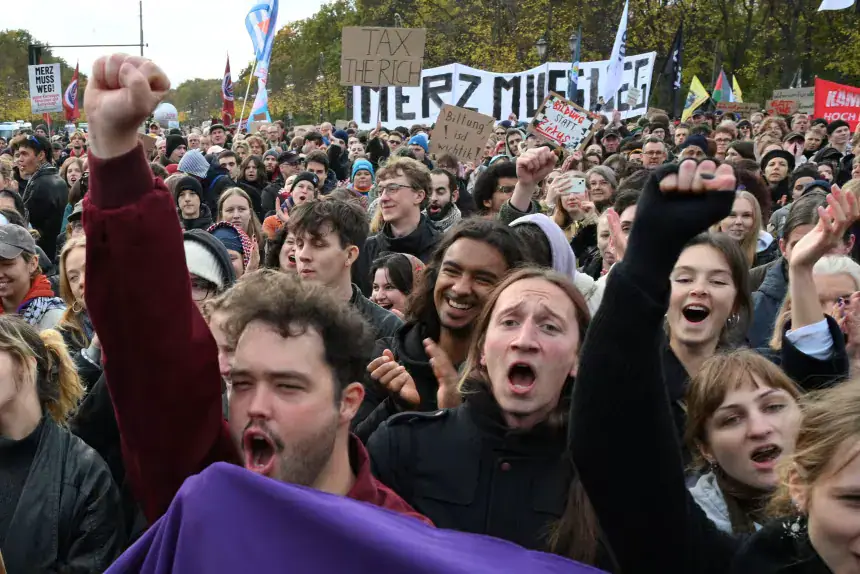
Tens of thousands of people took to the streets in Germany on Saturday, as part of a wave of protests inspired by the "Yellow Vests" movement in France. The protests, led by a new German youth-led movement dubbed "Gen Z has got this!", were held in major cities including Berlin, Frankfurt, Cologne, and Munich. The movement is protesting against the high cost of living, underfunded schools and universities, environmental concerns, and a potential reintroduction of mandatory military service.
In Germany, police in Cologne deployed water cannons and riot police after some protesters set off fireworks during a march in the city center. The police said the measures were directed against troublemakers and violent individuals, not against peaceful participants. In Hamburg, riot police responded after barriers were set on fire and emergency service workers were attacked. According to the organizers of 'Gen Z regelt', 120,000 people attended the protests across Germany on Saturday.
The protests in Germany follow a broader wave of protests that have swept Europe, including significant unrest in France. In France, more nationwide protests from the Yellow Vests movement took place on Saturday, in what has been billed as the third act of demonstrations. The French Interior Ministry said 320,000 people protested across the country on Saturday, with 70,000 turning up in Paris. That is a significantly smaller number than the 550,000 who demonstrated on October 17 and the 410,000 who showed up last week.
In France, the protests were mostly peaceful, except for a few incidents. The Interior Ministry said that "radical elements at the tail end of the processions" in several cities, including Bordeaux, Toulouse, Rennes, Lille, Nantes, Marseille, and Lyon, "attempted to enter city centers with the intent to cause damage and engage in looting." The ministry said the police intervened and "thwarted" those attempts. Jordan Bardella, the leader of France's far-right National Rally party, called for severe punishment for those who send "improvised incendiary devices" to law enforcement.
The French protests began in late September, led by high school students demanding improvements to deteriorating school buildings, teacher shortages, and a lack of resources, as well as changes to the university admissions system. The protests then morphed into something bigger, with the Yellow Vests, which began as a movement against soaring fuel prices, among those taking to the streets. The images of violence and looting from the October 17 protests are still haunting French officials.
French President Emmanuel Macron described the violence as a "collective failure." "I think no high school student started pushing for their demands expecting to suffer such terrible consequences. And I don't know a single police officer who signed up to find themselves caught up in such terrible and violent moments either," he told Youtuber Hu. The French Interior Ministry said that as of 6 p.m. local time, 296 people had been detained countrywide.
Halloween added a new complication to the protests in France, with Interior Minister Laurent Nuñez warning of separate calls for gatherings across France from 8 p.m. local time "by radical far-left groups and radicalized Yellow Vests." He said some messages invoked Halloween while calling for "revolution" and "insurrection," describing them as incitements to serious public disorder and warning that the gatherings would be banned.
Key points
- 120,000 people attended the protests across Germany on Saturday.
- 320,000 people protested across France on Saturday.
- French President Emmanuel Macron described the violence as a "collective failure".