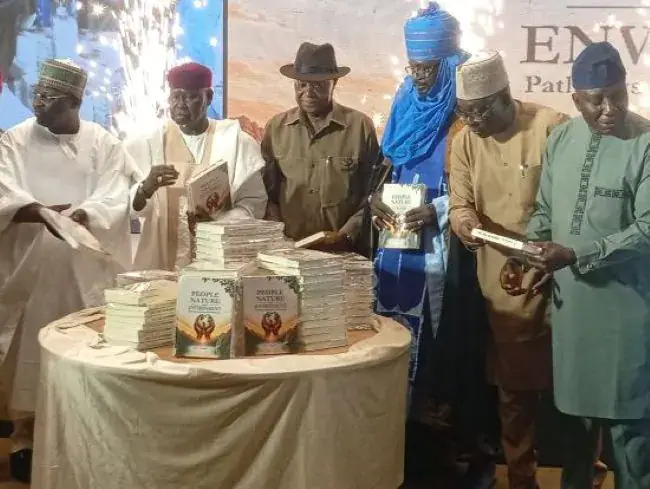
The Federal Ministry of Agriculture and Food Security has stressed that sustainable environmental management is vital for achieving long-term food security, agricultural productivity, and national prosperity in Nigeria. According to Senator Abubakar Kyari, who spoke on behalf of the Minister of Agriculture and Food Security, environmental sustainability is an indispensable foundation for the country's development. He made this statement at a book launch in Abuja, where the Ministry reiterated its commitment to environmental sustainability.
The book, "People, Nature and Environment: Pathways to Sustainable Development," was authored by Dr. Abba Maigida, a veteran public servant and scholar. Senator Kyari emphasized that food production is closely linked to the health of Nigeria's natural resources, including water bodies, forests, arable vegetation, and soil resources. He noted that environmental degradation poses a significant threat to farmlands, grazing fields, and aquatic ecosystems, which are the bedrock of the country's agricultural economy.
The Minister's statement aligns with the core insights of Dr. Maigida's book, which highlights the severe environmental challenges facing Nigeria, including rural gully erosion, desertification, and seasonal flooding. These challenges adversely impact agrarian livelihoods and threaten agricultural yields for present and future generations. Senator Kyari called on all Nigerians, local communities, and private sector investors to practice responsible land management and adopt climate-resilient farming frameworks.
The Chairman of the occasion, former Military Governor of Kwara State Gen. Alwali Kazeem, warned that competition over scarce agricultural land and water resources exacerbates rural displacement, food insecurity, and communal friction. He emphasized the need for unified action across government agencies, research institutions, and rural communities to address these challenges. The FCT Head of Service, Nancy Sabanti, cited climate change, rapid urbanization, and deforestation as shared challenges requiring immediate attention.
The book reviewer, Prof. Ishaya Sunday of the University of Abuja, commended the publication's focus on food security, water resource management, and disaster risk reduction. He noted that practical application will be key to turning these frameworks into real-world agricultural resilience. The Federal Ministry of Agriculture and Food Security remains committed to translating sustainability principles into concrete agricultural policies, programs, and field-level support to guarantee food sovereignty across Nigeria.
Dr. Abba Maigida, the author of the book, urged Nigeria to make environmental sustainability a national priority in its development policies and decisions. He drew on his experiences during more than two decades of public service, exposing him to the effects of environmental degradation, including erosion, desert encroachment, flooding, and pressure on housing and infrastructure. Dr. Maigida's book examined environmental sustainability, human development, housing, natural resource management, climate change, community development, public policy, and institutional responsibility.
The author expressed hope that the book would help policymakers, researchers, development practitioners, and communities translate sustainability principles into policies, programs, and practical action. He emphasized that development should not be measured only by the number of roads, buildings, and other physical structures provided, but also by the quality of life of the people, the conditions of communities, and the environmental consequences of decisions. The book took more than seven years to complete, drawing on research, field observations, and discussions with farmers, fishermen, traditional rulers, environmental professionals, and public servants.
Key points
- The Federal Ministry of Agriculture and Food Security emphasizes sustainable environmental management as crucial for achieving long-term food security and national prosperity in Nigeria.