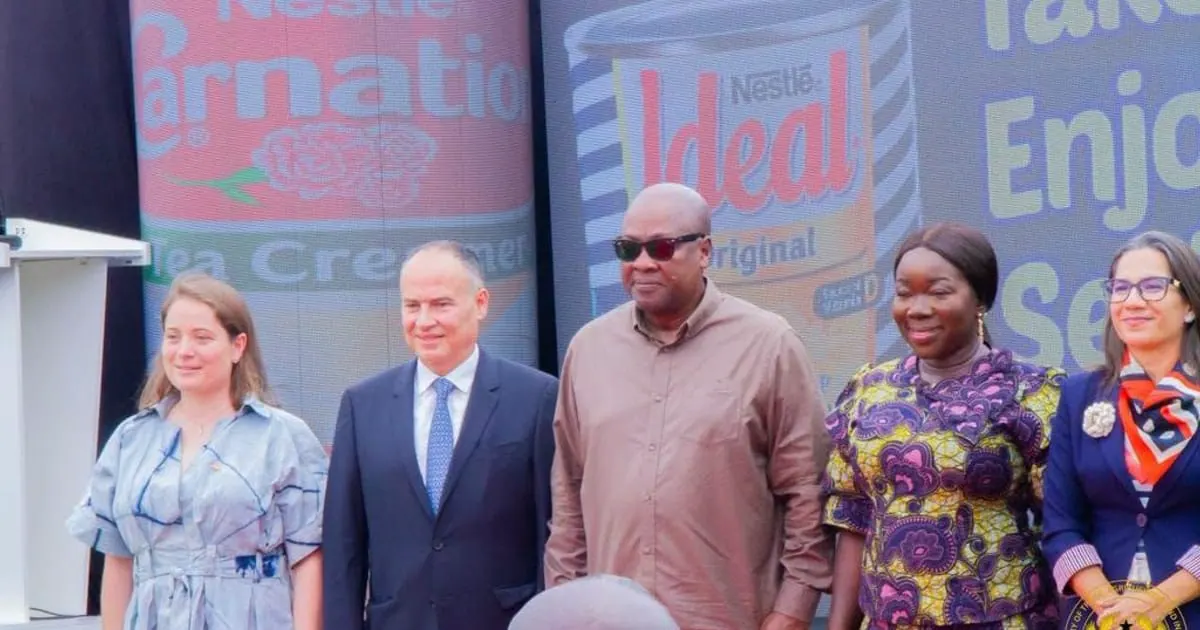
On October 8, 2026, President Mahama commissioned Nestlé Ghana's expanded evaporated milk production line at its Tema factory. This expansion increases the factory's evaporated milk production capacity to 30,000 tonnes annually. The new production line is capable of producing up to 500,000 cans per day. This development is part of Nestlé Ghana's efforts to strengthen its commitment to local manufacturing and Ghana's industrial development.
Managing Director of Nestlé Ghana, Salomé Azevedo, highlighted that the expansion almost doubles the factory's evaporated milk production capacity. She emphasized that this investment reflects Nestlé's confidence in Ghana's future and its commitment to expanding local manufacturing. Azevedo also noted that Nestlé's operations in Ghana began in 1957, the same year Ghana gained independence.
The Tema factory, commissioned in 1971, initially produced Ideal Milk among other products. Currently, it produces over 75,000 tonnes of products annually, including Milo, Cerelac, Ideal Milk, Carnation, and Nescafé. Azevedo mentioned that the factory operates 24 hours a day, seven days a week, and has continued to invest in sustainable production.
President Mahama described the investment as an important demonstration of Ghana's capacity to produce more of what it consumes and strengthen local manufacturing. He noted that the expansion aligns with the government's 24-hour economy initiative, which aims to promote continuous production, increase industrial activity, and create jobs.
Azevedo attributed the new production line to the work of teams that designed, installed, and tested the facility, as well as operators responsible for running it. She expressed that the investment is expected to further strengthen Nestlé Ghana's contribution to local manufacturing and create shared value for consumers, workers, families, and communities.
The expansion is seen as a significant milestone in Nestlé Ghana's history, building on a legacy of shared progress and reinforcing Ghana's position as a competitive manufacturing destination. Azevedo emphasized that the investment creates opportunities across the value chain and strengthens local value creation.
The commissioning of the expanded evaporated milk production line underscores Nestlé Ghana's commitment to local manufacturing and Ghana's industrial development. The company's long-standing presence in Ghana and its continued investments demonstrate its confidence in the country's future and its potential for growth.
Key points
- Nestlé Ghana expands evaporated milk production capacity to 30,000 tonnes annually.
- The new production line produces up to 500,000 cans per day.
- The expansion aligns with Ghana's 24-hour economy initiative.