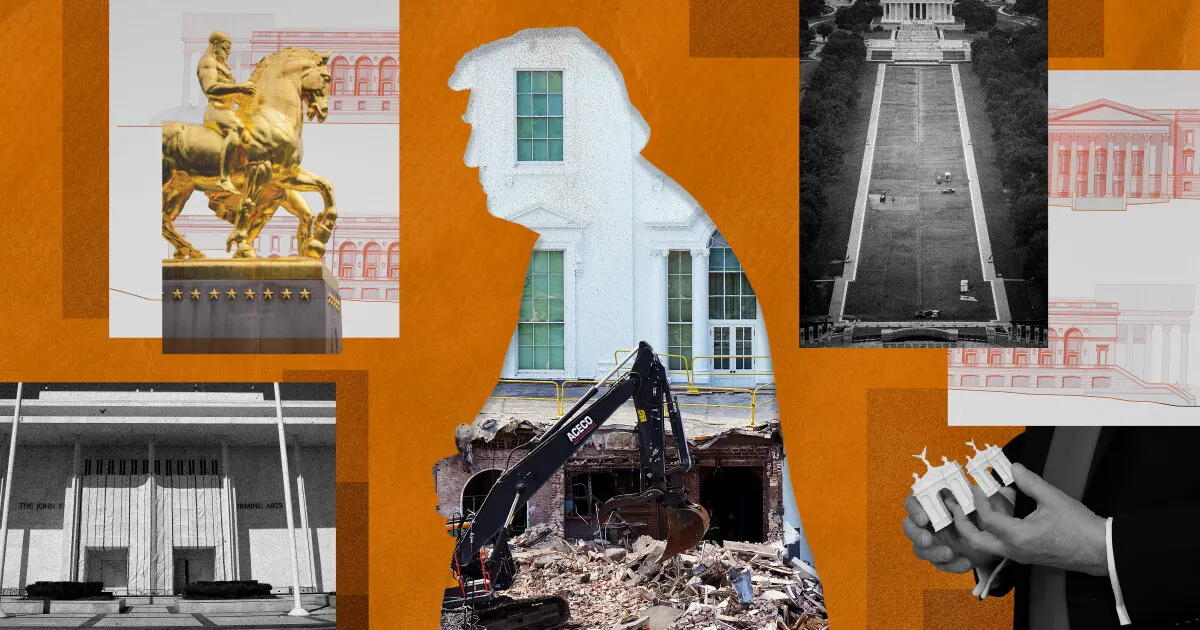
President Trump has been actively working to make his mark on Washington, D.C., during his second term, earning him the nickname "builder-in-chief." He has undertaken various projects, including the renovation of the East Wing of the White House, the construction of a helipad on the South Lawn, and the repaving of the Lincoln Memorial Reflecting Pool. These projects have been aimed at beautifying the nation's capital, but have also been met with controversy and criticism. Trump's approach to these projects has raised concerns about his disregard for historic preservation and the law.
Trump's projects have sparked numerous lawsuits, protests, and tens of thousands of public comments in opposition. His efforts to add his name to the Kennedy Center building or demolish it altogether have been met with resistance. Additionally, his plans for a 250-foot arch near Arlington National Cemetery have been rebranded as a military complex, despite initial claims that it was intended to honor him. These actions have led to concerns that Trump is treating D.C. as his personal construction playground.
According to Greg Werkheiser, a lawyer involved in several lawsuits against Trump's projects, the president's self-worth is tied to his mythology as a builder. Werkheiser stated that Trump has said, "I am president because I am rich. I am rich because I am a developer. I am a developer because I have exquisite taste." This approach has raised concerns among historians and legal experts, who worry that Trump is setting a dangerous precedent.
Trump's second-term projects have been justified as part of the country's 250th anniversary celebrations, but critics argue that he is rushing to memorialize himself out of fear that no one else will. Trump confirmed this in a New York Magazine piece, stating, "Nobody will do it once I'm gone. When I leave here, nobody will." This approach has been criticized, with many arguing that Trump's projects are driven by personal interests rather than the public good.
Trump's background as a New York City real estate developer has been cited as justification for his projects in D.C. However, those who worked with him in the past point out that his early-career building projects were often fraught with controversy and lawsuits. Barbara Res, who served as head of construction for the Trump Organization in the 1980s, stated that Trump's efforts to cut corners with ambitious projects are not new, but take on a painful significance in a moment when he is "ripping through" the nation's capital.
Res, who left the Trump Organization in 1998, stressed that there is a big difference between a builder and a developer. She stated that Trump often made demands about details that usually made the job harder, such as telling crews to reuse old HVAC equipment in new ductwork as a cost-cutting measure. Res is an outspoken Trump critic and has published a book about her experiences working with him.
Trump's history of disregard for historic preservation dates back to his early days as a developer. In 1979, he bought the flagship building of the Bonwit Teller luxury department on Manhattan's Fifth Avenue, with plans to tear it down and build Trump Tower in its place. However, he was persuaded to save the historic artwork on its facade, including two classical-style limestone sculptures and a massive art deco decorative metal grille. These artworks were eventually donated to the Metropolitan Museum of Art.
Key points
- President Trump's projects in Washington, D.C. have sparked controversy and criticism due to concerns about his disregard for historic preservation and the law.
- Trump's approach to these projects has raised concerns that he is treating D.C. as his personal construction playground.
- Trump's background as a developer has been cited as justification for his projects, but his early-career building projects were often fraught with controversy and lawsuits.