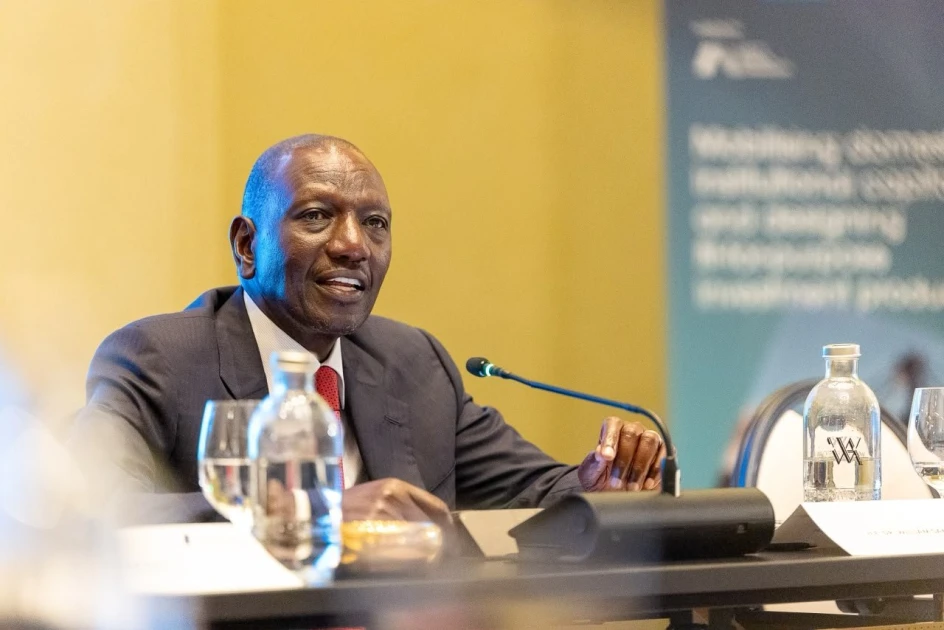
African countries have sufficient capital to drive economic growth and development, but are hindered by restrictive rules that dictate where investments can go, President William Ruto has said. According to the President, research by the African Finance Corporation has shown that Africa has the necessary resources to lay the foundation for economic takeoff. He made these remarks during the 'Africa We Build High Level Roundtable meeting', convened by the Africa Finance Corporation on the sidelines of the United Nations General Assembly meeting in New York.
President Ruto pointed out that African non-bank domestic capital pools have surpassed $2 trillion, with pension and insurance assets exceeding $1 trillion for the first time in history. He also noted that external flows to the continent between 2014 and 2024, including concessional and commercial funding, totaled $1.7 trillion. The President emphasized that Africa's own savings are now larger than external funding, but noted that Official Development Assistance has been declining since 2020.
Despite the availability of capital, President Ruto highlighted that financial rules are steering African pension savings towards government securities rather than infrastructure development. He cited the example of Kenyan pension funds, which hold 46% of their investments in government securities, but only 0.02% in infrastructure debt. The President noted that while regulations allow pension funds to invest up to 10% in infrastructure, they are not being utilized.
To address these challenges, President Ruto announced that Kenya will open its default and recovery data to rating agencies and accept changes to the methodology if the evidence supports them. He also revealed that Kenya has increased its equity investment in the Africa Finance Corporation by KSh3.25 billion ($25 million). In 2016, Kenya signed a Host Country Agreement with the AFC, establishing the financial institution's first regional office in Nairobi.
President Ruto also highlighted Kenya's efforts to mobilize domestic capital for infrastructure development. In May 2026, Kenya listed an infrastructure bond on the Nairobi Securities Exchange, raising KSh3.4 billion ($26 million) with the support of the United Kingdom. He noted that this was the first instrument of its kind that a Kenyan pension scheme can buy, and a step towards mobilizing larger investments.
Furthermore, President Ruto announced that Kenya has signed the National Infrastructure Fund into law, aiming to mobilize up to $40 billion for infrastructure development. The fund will be financed by capital that shares returns, rather than public debt. He emphasized that the goal is to work with domestic investors, rather than relying on external funding.
President Ruto called on African leaders and citizens to have faith in the continent and its countries, and to work together to transform the region. He also met with Alhaji Aliko Dangote, President and CEO of Dangote Industries, and Samaila Zabairu, President and CEO of the Africa Finance Corporation, to discuss the East African Refinery project in Lamu. The project aims to enhance energy security, deepen local value addition, create jobs, and advance industrialization in the region.
Key points
- Africa has sufficient capital to drive economic growth, but is hindered by restrictive rules that dictate where investments can go.
- President Ruto announced that Kenya will open its default and recovery data to rating agencies and accept changes to the methodology if the evidence supports them.
- Kenya has signed the National Infrastructure Fund into law, aiming to mobilize up to $40 billion for infrastructure development.