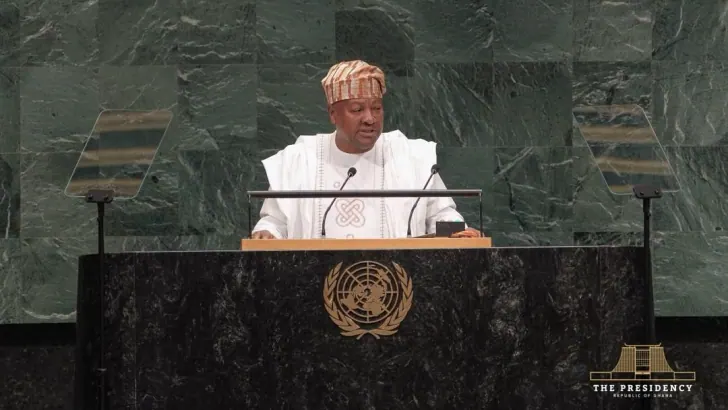
President John Dramani Mahama of Ghana delivered a thought-provoking address to the United Nations General Assembly, focusing on the concept of belonging and its significance in today's world. He began by reflecting on the idea that every person has an origin, carrying with them inherited memories, values, and distinct identities. This reflection served as a foundation for his discussion on the importance of belonging and its dual nature. While belonging can be a source of dignity and pride, it can also be exploited for political gain, leading to nativism, chauvinism, and prejudice.
President Mahama emphasized that the founding principle of the United Nations remains unchanged: every human being belongs to the human family, regardless of their background, language, faith, or color of skin. He stressed that no race is superior, no nation is inferior, and no child's life is worth less due to their land of birth. This moral foundation, he argued, must be the ground upon which the UN stands. The President's address was a call to reaffirm the UN's commitment to this principle and to work towards a more equitable global order.
Last year, President Mahama made a solemn pledge on behalf of Ghana, Africa, and the global African diaspora to secure international recognition of the transatlantic trafficking and racialized chattel enslavement of Africans as a grave crime against humanity. He addressed concerns that this effort would provoke division or render empty judgment, instead arguing that its purpose was to seek healing. President Mahama emphasized that true healing requires truth, acknowledgement, and meaningful repair. He highlighted the need to acknowledge the historical injustices faced by Africans and to work towards reparation.
The transatlantic slave trade and chattel enslavement of Africans have had a lasting impact on the continent and its people. President Mahama noted that millions of African men, women, and children were hunted, captured, trafficked, and exploited for profit. Their unpaid labor built the modern Western world, while Africa was left depopulated, with split families, structural disruption, and generational trauma. Ghana tabled Resolution A/RES/80/250 on March 25, 2026, which was supported by 123 nations. This resolution affirmed the fundamental truth that the transatlantic slave trade and chattel enslavement were grave crimes against humanity.
President Mahama also addressed the issue of global governance, highlighting the need for reform. Africa, with a population of 1.5 billion people and over 18% of humanity, remains without a permanent seat on the United Nations Security Council. This, he argued, is fundamentally unacceptable in the 21st century. The President emphasized that Africa must be granted permanent representation on the Council, with all the rights, responsibilities, and veto powers of such membership. This reform is essential for the legitimacy, credibility, and survival of the United Nations.
The international financial architecture also requires reform, according to President Mahama. Developing nations, including those in Africa and the Caribbean, face significant challenges due to crippling debt and predatory lending practices. Governments are often forced to choose between servicing debt and serving their people. The President advocated for long-term, affordable, and accessible concessionary financing that would enable developing economies to invest in human capital, industrialization, and climate adaptation.
In conclusion, President Mahama's address to the UN General Assembly emphasized the need for global repair and a more equitable global order. He called for moral standards to be applied uniformly across conflicts and for African leaders to prioritize transparency, accountability, and efficient use of resources. The President's message was one of hope and unity, emphasizing the importance of belonging to the human family and working towards a brighter future for all.
Key points
- President Mahama advocates for global repair and a more equitable global order.
- The transatlantic slave trade and chattel enslavement of Africans must be recognized as grave crimes against humanity.
- Africa must be granted permanent representation on the UN Security Council.