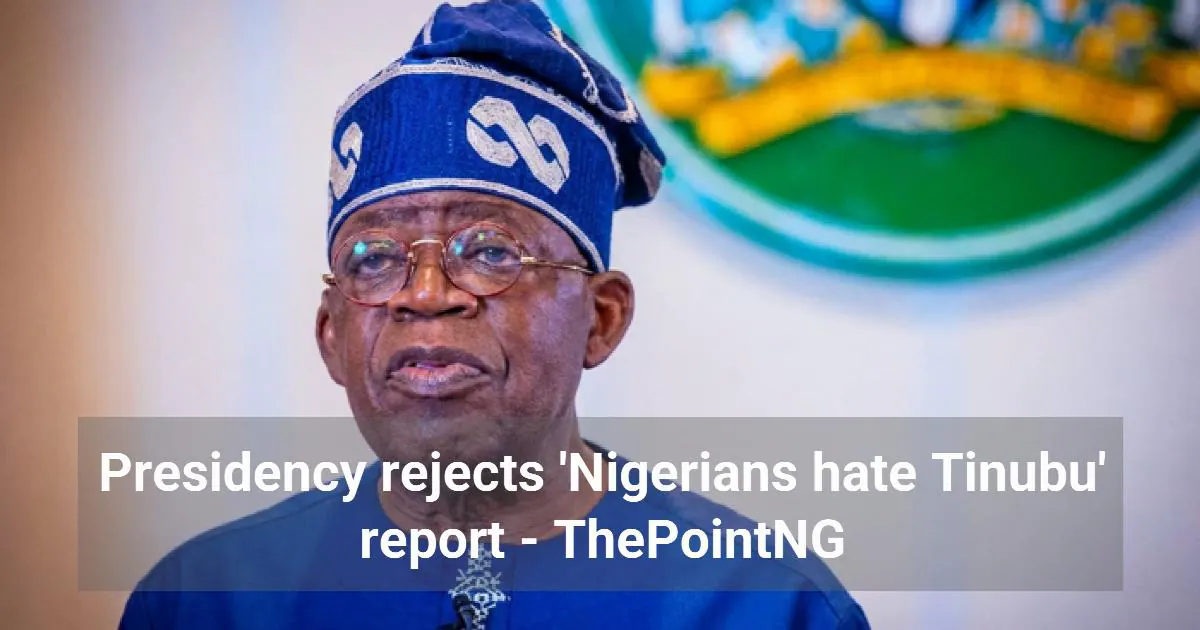
The Presidency of Nigeria has strongly rejected a report by The Economist, which claimed that Nigerians dislike President Bola Tinubu. In a statement signed by Special Adviser to the President on Media and Public Communications, Sunday Dare, the Presidency described the assertion as "intellectual fraud" and insisted that the President's economic overhaul is unstoppable. The statement titled 'Beyond the Economist Condescension: Nigeria's Re-engineering Under Tinubu is Unstoppable' accused the foreign publication of pushing a false narrative about the President's standing with Nigerians.
According to the Presidency, it has become a predictable ritual for foreign publications to view Nigeria through a "cracked, distorted lens". The statement argued that such observers routinely "traffic in sensationalist half-truths" in their rush to paint a picture of impending doom and widespread citizen despair. The Presidency accused The Economist of peddling a "lazy, hollow fiction" that Nigerians hate President Tinubu, saying this overlooks the monumental task of national salvage undertaken by the Tinubu administration since May 2023.
The Presidency pointed to the catastrophic state of the economy when President Tinubu's administration began, inheriting a broken economic ecosystem on the precipice of total sovereign bankruptcy. President Tinubu did not inherit a functioning state; instead, he faced a monumental financial leak from the opaque, resource-draining, and rent-seeking fuel subsidy regime. This regime operated as a financial drain, feeding the greed of a parasitic portfolio oil mafia while mortgaging the future of generations.
The statement also noted that for decades, the foreign exchange market, public finances, and national assets were in a deplorable state before 2023. The Nigerian economy groaned under multiple, distorted foreign exchange windows that bred corruption and choked legitimate enterprise. Debt service-to-revenue ratios hovered near 95 percent, leaving the treasury virtually empty. Decades of underinvestment left critical national assets, security architecture, energy grids, and infrastructural arteries severely fractured.
The Presidency defended the pain that accompanied the reforms, saying that to suggest these structural cancers could be excised overnight without transitional pain is economically illiterate. Rather than postpone his economic reforms, President Tinubu summoned the political courage to confront these structural contradictions head-on. The administration has systematically dismantled decades of economic distortion through a series of hard-core, visionary policies that have fundamentally altered Nigeria's trajectory.
The Presidency listed several achievements of the Tinubu administration, including the removal of the fuel subsidy, forex reform, and the Nigerian Education Loan Fund. By decisively terminating the burdensome fuel subsidy, the administration stopped the bleeding of national resources, saving the federation trillions of Naira and redirecting funds toward productive capital development and fiscal sustainability. The implementation of the Nigerian Education Loan Fund has transformed the academic landscape, with hundreds of thousands of indigent students now pursuing higher education without the burden of tuition.
The Presidency also credited President Tinubu with several other achievements, including local government autonomy, a higher minimum wage, cheaper commuting, and support for farmers. The administration has championed and secured financial autonomy for local governments, brought governance directly to the grassroots, and ensured allocations reach local communities without state-level bottlenecks. The upward review of the national minimum wage and targeted palliatives have cushioned millions against inflationary pressures.
Key points
- The Presidency rejects The Economist's claim that Nigerians dislike President Tinubu, calling it "intellectual fraud".
- President Tinubu's administration has implemented several economic reforms, including the removal of fuel subsidy and forex reform.
- The administration has achieved several milestones, including local government autonomy, a higher minimum wage, and support for farmers.