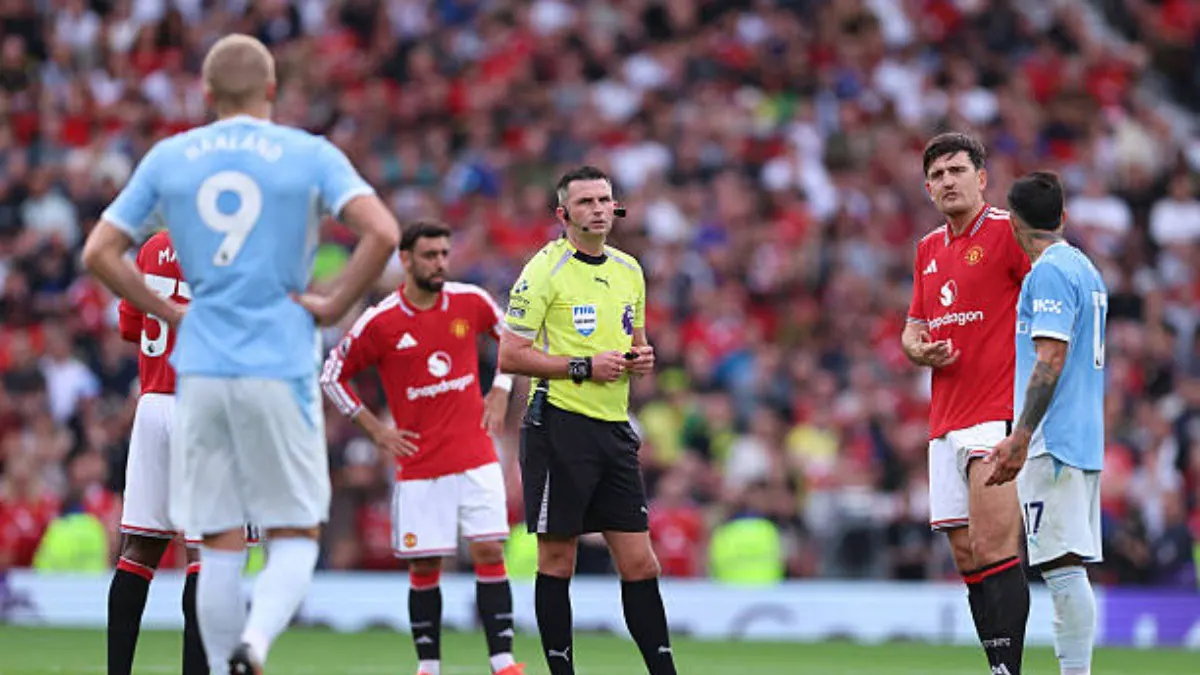
The Premier League's latest VAR controversy has raised questions about accountability in refereeing decisions. The incident occurred during Manchester City's 1-0 victory over Manchester United at Old Trafford, where Erling Haaland's 60th-minute winner was initially ruled out for offside before being overturned. A lengthy video review established that Haaland was in an onside position but failed to properly assess the role of his teammate, Enzo Fernández, who was positioned offside and appeared to interfere with Manchester United's defensive actions.
Days later, Howard Webb, Pro Ref's chief refereeing officer, admitted that the decision was wrong and described the VAR process as suffering from "tunnel vision". Webb confirmed that the goal should have been disallowed and said he was "really disappointed" with the outcome. Pro Ref also contacted Manchester United to acknowledge the error, while VAR official Matt Donohue and assistant VAR Blake Antrobus were stood down until after the international break. The admission was swift, but the consequence remained limited to the officiating team, with Manchester United still losing the derby and Manchester City retaining the three points.
The controversy at Old Trafford was not simply about whether Haaland was onside, but also about Fernández's movement towards the ball without making contact. Under the Laws of the Game, a player does not necessarily need to touch the ball to be penalized for offside. Interfering with an opponent can be sufficient, particularly where the player's movement affects a defender's ability to challenge or a goalkeeper's ability to respond. Webb acknowledged that Fernández's actions likely affected both Lisandro Martínez and goalkeeper Senne Lammens.
The VAR team, however, concentrated on whether Haaland was onside and whether Fernández had touched the ball. Once the officials established that Haaland was onside and Fernández had made no contact, the review proceeded towards approving the goal. The full attacking phase was not properly evaluated, which matters because VAR is not designed merely to identify one technically correct element of an incident. Its purpose is to review the relevant phase of play and determine whether the final decision should stand.
The Premier League has begun publishing Key Match Incidents Panel assessments in an effort to improve transparency. That initiative gives the public greater access to how controversial decisions are evaluated after matches. However, it also creates a difficult question: does publishing an error provide meaningful accountability when the sporting consequences remain untouched? The difference between transparency and remedy is crucial in this context.
There is an important distinction between acknowledging a mistake and providing a remedy. In the case of the Manchester derby, Pro Ref accepted that the goal should not have stood, and the officials were removed from the following weekend's appointments. Those measures are not meaningless, as reviewing errors and examining communication failures can form part of a system designed to improve performance. However, those actions do not address the competitive impact of the original decision.
The Premier League's VAR errors have sparked debate on accountability, with Arsenal's penalty controversy against Aston Villa adding to the pressure. The league's refereeing leadership must balance transparency with meaningful consequences for incorrect decisions. As the season progresses, it remains to be seen how the Premier League will address these concerns and ensure that VAR is used effectively to support refereeing decisions.
Key points
- The Premier League's VAR errors have raised questions about accountability in refereeing decisions.
- The league's refereeing leadership must balance transparency with meaningful consequences for incorrect decisions.
- The use of VAR has sparked debate on the need for more effective implementation and review processes.