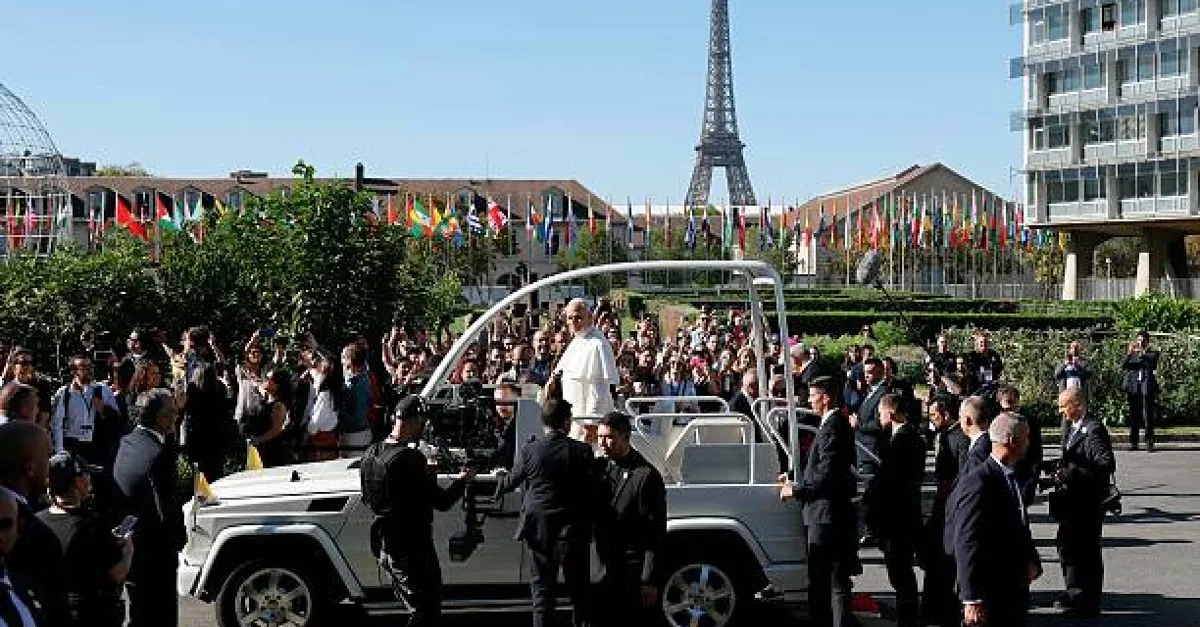
Pope Leo XIII has arrived in Paris for a historic visit, his sixth since becoming Pope over a year ago. This marks the first time a Pope has visited Paris in 18 years. The visit is described as "apostolic" rather than a state visit, reflecting a shift in the tone of relations between the Vatican and France. The Pope's schedule includes 26 meetings over four days, focusing on spiritual and diplomatic engagements.
French President Emmanuel Macron had initially requested a state visit, but the Vatican insisted on describing the trip as "apostolic." As a result, Macron will not attend any of the Pope's masses, although his wife Brigitte and Prime Minister Sebastian Lecornu will represent him at a major ceremony on Saturday. This visit marks a significant change in relations between the Vatican and France, as Pope Leo's predecessor, Pope Francis, had previously avoided official state visits to France.
The Pope's visit comes at a time when Europe is grappling with an identity crisis, and the Church's voice is being sought. The Pope's program includes a meeting with Macron and leaders of the European Union, where they will discuss the future of Europe and the search for peace and unity. Analyst Massimo Faggioli notes that the Church's voice is being heard more clearly in Europe, particularly in the face of rising populism.
The Vatican's diplomatic influence extends beyond its official relations with 184 countries, with a vast network of informants and diplomats providing valuable insights. According to Francois Maabel, director of the IRIS Observatory for Religious Geopolitics, the Vatican plays a unique role as an international arbiter, leveraging its reputation for impartiality to facilitate dialogue.
Pope Leo XIII's approach differs from his predecessor, with a greater emphasis on international law, multilateralism, and the role of UN institutions. He has spoken out against Russia's war in Ukraine and Israeli actions in Palestine, and criticized US threats against Iran. The Vatican seeks to maintain its neutrality, allowing it to play a mediating role.
The visit also highlights the growing interest in spirituality in France, with rising numbers of adult baptisms despite the country's strong secular traditions. Analyst Faggioli notes that the Vatican is concerned about the rise of populism in Europe, particularly in France, where an election may lead to the far-right coming to power.
The Pope's visit to Paris has significant implications for the Catholic Church and its role in Europe. As the Church seeks to navigate a changing continent, Pope Leo XIII's visit marks an important moment in its efforts to engage with the world and promote peace and understanding. The visit will be closely watched by observers around the world.
Key points
- The Pope's visit to Paris marks a significant shift in relations between the Vatican and France.
- The visit highlights the growing interest in spirituality in France despite its strong secular traditions.
- The Pope's approach emphasizes international law, multilateralism, and the role of UN institutions.